As many of you are aware, President Obama's nominee for Secretary of Health and Human Services (HHS), Governor Kathleen Sebelius of Kansas remains unconfirmed, which is hampering the ability of the administration to act in a number of key areas. States are waiting for guidance from HHS to fully implement the Fostering Connections to Success and Increasing Adoptions Act of 2008 and assist children being raised by grandparents and other relatives.
I was pleased to read from Governor Sebelius' confirmation hearing in front of the Senate Finance Committee that both the Finance Committee and the Governor view implementing the Fostering Connections Act as an important priority. Both Senators Baucus and Rockefeller choose to use some of their time to ask Governor Sebelius about the new law. Let's hope that she can get to work quickly.
I have attached some of the highlights for you:
Senator Baucus: Last year, Senator Grassley and I worked together, along with other members of this committee, to pass the ―Fostering Connections and Increasing Adoptions Act. Implementation of that bill will require your immediate attention. Are you prepared to begin the implementation of this landmark piece of legislation? How should we interpret the constant rate of entries into foster care? What policies can reduce entries into foster care?
Governor Sebelius: I applaud your leadership and vision in enacting the Fostering Connections and Increasing Adoptions Act. If I am confirmed, implementing this landmark legislation will be a high priority for me, and for my team at HHS. Consistent with the goals of safety, permanency, and well-being, it will be vital to invest in up-front services to strengthen families and avoid foster care placements where possible. These early services will need to link closely with family and other community-based supports for vulnerable families.
Senator Baucus: Do you see the need for the development of age-specific and culturally appropriate approaches to prevention of abuse and neglect and/or prevention of entry to foster care? What should HHS‘ role be in developing such approaches and/or tailoring existing programs to improve age-specific, developmentally, and culturally appropriate services? How do you see HHS‘ role in addressing parental "risk factors"? Are risk factors most appropriately addressed in child welfare policy or in other ways – for example, income security or via broader based mental health, substance abuse, and domestic violence related services?
Governor Sebelius: If confirmed as Secretary of HHS, I intend to look closely at evidence-based approaches for preventing abuse and neglect and/or foster care placement. Parental ―risk factors should be addressed through both the broader-based approaches you mentioned and child welfare policy. It would seem very reasonable to examine tailored strategies that have proven effective in particular settings. HHS has an important role to play in promoting public health, including mental health, and in working with state, local, and tribal partners to provide direct services that support individual at-risk families.
Senator Rockefeller: Last fall, Congress passed a bipartisan bill that I was pleased to work on with Chairman Baucus and Senator Grassley called the Fostering Connections and Increasing Adoptions Act. HHS will need to implement this historic legislation to increase adoptions and allow states the option to help grandparents raising their grandchildren by guardianship.
Adoption and child welfare don‘t dominate the news, but having a safe permanent home is essential for a child‘s healthy development and future. We hope to work with you on strong implementation. I would appreciate hearing you views on adoption and child welfare issues
Governor Sebelius: I applaud your steadfast leadership on the issue of child welfare reform and advocacy, and I appreciate your central role in passing the Fostering Connections and Increasing Adoptions Act. I recognize that the Department of Health and Human Services has a special responsibility to our most vulnerable people, and that children who suffer abuse and neglect deserve our attention even if their plight does not dominate the news. If confirmed, I look forward to working with you to identify other opportunities to improve outcomes for children served by the child welfare system, and to increase adoptions so that more children receive the benefit of a safe, loving, and permanent home.

Tuesday, April 14, 2009


Wednesday, April 08, 2009
GU Is New on Facebook
Generations United is increasing its presence on the web. We have launced our own fan page on facebook! You can become a fan of Generations United and stay in touch with all the developments from GU and connect with others in the intergenerational field. Look forward to seeing everyone there.
Here's our link:
http://www.facebook.com/home.php#/pages/Generations-United/76354509988
Here's our link:
http://www.facebook.com/home.php#/pages/Generations-United/76354509988
Monday, April 06, 2009
'Grandfamilies' Come Under Pressure (Wall Street Journal)
Saturday's Wall Street Journal included a very thoughtful story on the hardship grandfamilies are facing in the economic downturn. The article reports that older workers often have greater trouble in finding new employment after losing their jobs. Extended unemployment can present unique risks for grandfamilies. Additionally, as our own Ken Bryson points out in the article, the rate of grandfamilies continues to grow in the country.
Despite the difficulties grandfamilies may be facing, it's heartening to know that children being raised by grandparents and other relatives have a loving grandparent committed to their future. These grandparents have made great sacrifices to make sure our nation's children stay out of the foster care system (at great benefit for taxpayers) and deserve our support.
Despite the difficulties grandfamilies may be facing, it's heartening to know that children being raised by grandparents and other relatives have a loving grandparent committed to their future. These grandparents have made great sacrifices to make sure our nation's children stay out of the foster care system (at great benefit for taxpayers) and deserve our support.
Tuesday, March 24, 2009
Generations United Conference Registration Now Open!
Team GU is hard at work with our terrific conference planning committee gearing up for our 15th Intergenerational Conference. How exciting! Registration is now open and available to you on line at register online . The conference will take place July 27 – 31, 2009 at the Hyatt Regency in Washington, DC and promises to be one of our best yet. I saw Marc Freedman, GU board member and President of Civic Ventures, last week and he told me he is so looking forward to giving the keynote at the opening plenary session that when he recently lost his calendar, the first thing he added to his new datebook was the Generations United Conference. So, take the lead from one of the premier social entrepreneurs in the country and hurry up and register to join us this summer!
We’re planning to host over 400 innovators, leaders, experts, administrators, managers, academics, and advocates in a variety of youth and aging fields who will come together to explore intergenerational topics and issues. Over 75 workshops, roundtables, poster sessions and discussion groups are scheduled covering a wide-range of intergenerational practices, research and public policy initiatives.
We are also offering a tour of the outstanding new Easter Seals intergenerational shared site, preconference intensives on grandfamilies and intergenerational programs, along with our crowd-pleasing awards dinner and day on Capitol Hill. We only throw a party in WDC every other year so join us, you won’t be disappointed!
We’re planning to host over 400 innovators, leaders, experts, administrators, managers, academics, and advocates in a variety of youth and aging fields who will come together to explore intergenerational topics and issues. Over 75 workshops, roundtables, poster sessions and discussion groups are scheduled covering a wide-range of intergenerational practices, research and public policy initiatives.
We are also offering a tour of the outstanding new Easter Seals intergenerational shared site, preconference intensives on grandfamilies and intergenerational programs, along with our crowd-pleasing awards dinner and day on Capitol Hill. We only throw a party in WDC every other year so join us, you won’t be disappointed!
Wednesday, February 25, 2009
President Calls for a New Era of Innovation
In last night’s address to a joint-session of Congress, President Obama called for a new era of innovation to lead the country out of the recession. It was an unprecedented call for reform and comprehensive action across almost all sectors of economy and all segments of society. It’s been a long time since the nation has been asked to act this boldly.
Meeting this call to action will require engaging both young and old. For all three of the major policy initiatives identified by the President last night (education, healthcare, and energy) there are proven models that engage all generations in creative solutions.
In President Obama’s call for education reform, he indicated how important early childhood education is to the recovery and long-term growth of the country. One of the best ways to promote early childhood education is to engage our senior population to mentor our children in schools and Head Start and Early Head Start programs. Generations United is calling for Congress to incentivize the construction of intergenerational shared sites so children and seniors are more easily connected. Additionally, the success of Generations United’s Seniors4Kids initiative (seniors advocating for universal and high-quality Pre-K) in states like Florida, New York, and Kentucky proves early childhood education is an effective intergenerational cause.
President Obama also called for school reform so that we are providing innovative schools and motivated teachers for our students. The Intergenerational School in Cleveland, Ohio is a perfect example of an innovative charter school. The school, which has been one of the most high-performing schools in the Cleveland school district, utilizes senior mentors in the curriculum. The administration should also consider expanding successful teacher mentoring programs that pair retired teachers with current teachers.
The second major initiative President Obama addressed was health care reform. It was encouraging to hear the President say that he wants to pass comprehensive health care reform this year. Not enough children and families have health insurance and those that do have insurance pay too much for inefficient and incomplete coverage.
President Obama also called on for Energy reform and innovation. Leaving a healthy and thriving planet for future generations is an idea shared by the original Americans – Native Americans. "Seven Generations” refers to a core philosophical value of American Indians, which states that for the well being of future generations, the responsibility rests on every generation that comes before them. If we act and make decisions that have the best interest of the Seventh Generation, our unborn generation, we will ensure healthy future generations. In even as complex an issue as energy reform, intergenerational programs can play a helpful role. An example is one volunteer program in Florida has young people to help seniors make their homes more energy efficient.
Regardless of the policy initiative, intergenerational solutions have shown to be exactly the kind of innovation President Obama called for last night. Lastly, let me add that I was inspired to hear the President’s call to pass the Kennedy-Hatch Serve America Act. Some of the best examples of intergenerational service, such as Senior Corps and AmeriCorps, are strengthened by this bill. These programs are part of the Corporation for National and Community Service, which is long-over due for reform that can match the capacity of this country’s desire to serve.
Meeting this call to action will require engaging both young and old. For all three of the major policy initiatives identified by the President last night (education, healthcare, and energy) there are proven models that engage all generations in creative solutions.
In President Obama’s call for education reform, he indicated how important early childhood education is to the recovery and long-term growth of the country. One of the best ways to promote early childhood education is to engage our senior population to mentor our children in schools and Head Start and Early Head Start programs. Generations United is calling for Congress to incentivize the construction of intergenerational shared sites so children and seniors are more easily connected. Additionally, the success of Generations United’s Seniors4Kids initiative (seniors advocating for universal and high-quality Pre-K) in states like Florida, New York, and Kentucky proves early childhood education is an effective intergenerational cause.
President Obama also called for school reform so that we are providing innovative schools and motivated teachers for our students. The Intergenerational School in Cleveland, Ohio is a perfect example of an innovative charter school. The school, which has been one of the most high-performing schools in the Cleveland school district, utilizes senior mentors in the curriculum. The administration should also consider expanding successful teacher mentoring programs that pair retired teachers with current teachers.
The second major initiative President Obama addressed was health care reform. It was encouraging to hear the President say that he wants to pass comprehensive health care reform this year. Not enough children and families have health insurance and those that do have insurance pay too much for inefficient and incomplete coverage.
President Obama also called on for Energy reform and innovation. Leaving a healthy and thriving planet for future generations is an idea shared by the original Americans – Native Americans. "Seven Generations” refers to a core philosophical value of American Indians, which states that for the well being of future generations, the responsibility rests on every generation that comes before them. If we act and make decisions that have the best interest of the Seventh Generation, our unborn generation, we will ensure healthy future generations. In even as complex an issue as energy reform, intergenerational programs can play a helpful role. An example is one volunteer program in Florida has young people to help seniors make their homes more energy efficient.
Regardless of the policy initiative, intergenerational solutions have shown to be exactly the kind of innovation President Obama called for last night. Lastly, let me add that I was inspired to hear the President’s call to pass the Kennedy-Hatch Serve America Act. Some of the best examples of intergenerational service, such as Senior Corps and AmeriCorps, are strengthened by this bill. These programs are part of the Corporation for National and Community Service, which is long-over due for reform that can match the capacity of this country’s desire to serve.
Thursday, February 05, 2009
Applauding SCHIP and Staying Vigilant on Economic Recovery Act
Legislation is moving at a fast place on Capitol Hill and each day brings its own opportunities and challenges.
Yesterday, a vital expansion of the Children’s Health Insurance Program was signed into law by the President Obama. The new law will provide health insurance to four million uninsured and vulnerable children. This is a crucial victory for children and the country, particularly during this economic downturn. During the signing-ceremony President Obama said providing health care for children was the, “duty of any decent society.” I couldn’t agree more.
Today, the news was decidedly different. The Senate is debating the economic recovery plan to kick start the economy and provide for long-term investments that will grow our economy for years to come. While no bill is perfect, especially one that has almost a trillion dollars of spending in it, I believe that funding initiatives like Head Start and school construction are the epitome of what Congress should be trying to pass. These initiatives provide tremendous intergenerational opportunities that should be promoted rather than pared.
Yesterday, a vital expansion of the Children’s Health Insurance Program was signed into law by the President Obama. The new law will provide health insurance to four million uninsured and vulnerable children. This is a crucial victory for children and the country, particularly during this economic downturn. During the signing-ceremony President Obama said providing health care for children was the, “duty of any decent society.” I couldn’t agree more.
Today, the news was decidedly different. The Senate is debating the economic recovery plan to kick start the economy and provide for long-term investments that will grow our economy for years to come. While no bill is perfect, especially one that has almost a trillion dollars of spending in it, I believe that funding initiatives like Head Start and school construction are the epitome of what Congress should be trying to pass. These initiatives provide tremendous intergenerational opportunities that should be promoted rather than pared.
Friday, January 30, 2009
SCHIP SUCCESS
I’m thrilled to report that yesterday the Senate approved legislation for SCHIP, which will provide health insurance to 11 million low-income children.
With President Obama on board, more children will have a chance to get the health coverage they so deserve. Mr. Obama has promised to provide coverage to every American child.
As the President said in a statement, "Providing health care to more than ten million children through the Children's Health Insurance Program will serve as a down payment on my commitment to ensure that every American has access to quality, affordable health care."
In the current economy, that health care will be invaluable for every child to have an opportunity for the success they deserve.
To find out more about SCHIP and learn about the Policy’s work on the legislation, go to http://ipath.gu.org/SCHIP10271521.asp.
With President Obama on board, more children will have a chance to get the health coverage they so deserve. Mr. Obama has promised to provide coverage to every American child.
As the President said in a statement, "Providing health care to more than ten million children through the Children's Health Insurance Program will serve as a down payment on my commitment to ensure that every American has access to quality, affordable health care."
In the current economy, that health care will be invaluable for every child to have an opportunity for the success they deserve.
To find out more about SCHIP and learn about the Policy’s work on the legislation, go to http://ipath.gu.org/SCHIP10271521.asp.
Friday, January 09, 2009
It's Official: White House to be Multi-Generational!
There is already some exciting news to share with you in the new year. The New York Times is reporting that Mrs. Obama's office has confirmed that Marian Robinson, mother of the incoming first lady will be living in the White House. Mrs. Robinson, as you can read below has been a big help in raising the Obama's two young daughters and is a wonderful role-model for grandparents everywhere.
Wednesday, December 17, 2008

Wednesday, November 19, 2008
White House Grandma
The nation’s incoming first family sets a precedent in so many ways. I appreciate how the energy of young people helped Obama get to where he is today, but let’s not forget older adults have nurtured President-elect Barack Obama throughout his life as well. Obama’s late maternal grandmother, Madelyn Dunham, whom he affectionately called "Toot," deeply impacted his life while helping to raise him in Hawaii. And now Marian Robinson, grandmother to Barack and Michelle Obama's children, may move into the White House with her daughter and son-in-law. The Washington Post reported this week that the Obamas are busy touring D.C. schools. I wouldn’t be surprised if Marian Robinson, who stepped in when her daughter and son-in-law were campaigning, driving her granddaughters to and from play dates, dance, and piano lessons, has some say in their important decision.
Multigenerational households happen for many reasons, some by choice, some by necessity. The Obamas serve as an example of choosing to live under one roof. Having cared for her grandchildren as her daughter and son-in-law’s schedules filled up, why, once the race was over, would she not want to remain deeply involved with the girls and join in the family’s D.C. move? As the latest Census reported, the number of parents under 65 in multigenerational households increased by 75%, while those 65 and older rose 62%. Additionally, the data shows a 40% increase in the number of other live-in relatives, such as the head of household's mother-in-law or father-in-law to 6.8 million. You can download GU’s multigenerational household fact sheet by clicking here.
Multigenerational households happen for many reasons, some by choice, some by necessity. The Obamas serve as an example of choosing to live under one roof. Having cared for her grandchildren as her daughter and son-in-law’s schedules filled up, why, once the race was over, would she not want to remain deeply involved with the girls and join in the family’s D.C. move? As the latest Census reported, the number of parents under 65 in multigenerational households increased by 75%, while those 65 and older rose 62%. Additionally, the data shows a 40% increase in the number of other live-in relatives, such as the head of household's mother-in-law or father-in-law to 6.8 million. You can download GU’s multigenerational household fact sheet by clicking here.
Friday, November 14, 2008
National Adoption Day
Tomorrow – Saturday, November 15 – is National Adoption Day. National Adoption Day is a collective national effort to raise awareness of the 129,000 children in foster care waiting to find permanent, loving families. When I hear about the thousands of children waiting for stability and a loving family as they wait in foster care, I’m again thankful for the passage of the Fostering Connections to Success and Increasing Adoptions Act of 2008. The Act will help thousands of children and youth by promoting permanent families for children in foster care through relative guardianship and adoption and helping with access to other supportive services for grandparent- and other relative- headed families. The bill will also do such things as extend federal support for youth to age 21 and help keep brothers and sisters together. To learn more about National Adoption Day, go to http://www.nationaladoptionday.org/2008/index.asp. To find out the latest on Fostering Connections to Success and Increasing Adoptions Act of 2008, go to GU’s special public policy web page at http://www.gu.org/Polic7231752.asp.
Wednesday, October 29, 2008
Hockey Star Heads Home to be with Grandfather
It’s not just politicians like Barack Obama that are taking some time out to visit with their ailing grandparents. Alexander Ovechkin of the Washington Capitols, last year’s most valuable player in the National Hockey League left the team yesterday so that he could fly home to Moscow to be with his grandfather, Nikolay Kabayev. Ovechkin’s grandfather helped care for him when he was young and it’s touching to hear that he wants to be there beside him now that he is ill.
Ovechkin has played in a remarkable 203 straight games for the Capitols (something I can really appreciate as the spouse of a hockey enthusiast). So while Capitols missed Ovechkin on the ice at last night’s game, I’m sure everyone understood how important it was for him to be with his grandfather. At Generations United we send our sympathies to Ovechkin and his family during this difficult time
Ovechkin has played in a remarkable 203 straight games for the Capitols (something I can really appreciate as the spouse of a hockey enthusiast). So while Capitols missed Ovechkin on the ice at last night’s game, I’m sure everyone understood how important it was for him to be with his grandfather. At Generations United we send our sympathies to Ovechkin and his family during this difficult time
Thursday, October 23, 2008
Response to Samuelson
In yesterday’s Washington Post Robert Samuelson addressed a memo to young voters and asked them to get angry because they are supposedly being duped by an alliance of senior voters and the two presidential campaigns in an effort to ignore them and their issues. Samuelson has long been banging the drum for entitlement and budget reform, and he often raises legitimate questions, but his solutions and tactics are misplaced and wrongheaded.
There’s a good reason why young voters aren’t angry with seniors (much to Samuelson’s dismay); after all, they care about their own parents and grandparents and they understand that they too will age. Further, he narrowly lays the blame of the budget deficit on older adults. He omits the cost of tax expenditures, bail outs, two wars, and the inefficiencies in our health system.
Older Americans do care about youth and how they will leave the country for them. It’s the reason we’ve seen such an up rise in senior civic engagement, especially with children and youth. GU’s Seniors4Kids is a perfect example of elders selflessly advocating for a brighter beginning for a younger generation. If you have a moment, please leave a comment on the Washington Post and remind Samuelson that we are all in this together, both young and old and the only way to solve our challenges, which are many, is to work together. Click here for the article and here to leave a comment.
There’s a good reason why young voters aren’t angry with seniors (much to Samuelson’s dismay); after all, they care about their own parents and grandparents and they understand that they too will age. Further, he narrowly lays the blame of the budget deficit on older adults. He omits the cost of tax expenditures, bail outs, two wars, and the inefficiencies in our health system.
Older Americans do care about youth and how they will leave the country for them. It’s the reason we’ve seen such an up rise in senior civic engagement, especially with children and youth. GU’s Seniors4Kids is a perfect example of elders selflessly advocating for a brighter beginning for a younger generation. If you have a moment, please leave a comment on the Washington Post and remind Samuelson that we are all in this together, both young and old and the only way to solve our challenges, which are many, is to work together. Click here for the article and here to leave a comment.
Tuesday, October 21, 2008
In Honor of a Grandmother

Last night on Anderson Cooper there was one really poignant moment when Joe Madison, a radio host, was making a point about something else and he stopped in the middle of what he was saying and added:
“And I'd like to say about grandparents. I was reared by Betty Stone and Jim Stone, my grandparents. And Barack Obama has no choice; he has to go to his grandmother's side. I think it's a smart thing to do. If he didn't, he'd probably regret it the rest of his life.”
Indeed. Having just lost my father, I cherish the time this summer when I put my life on hold and went to be with him. I would not have missed the last days with my last parent for anything.
And we know how important Senator Obama’s grandmother is to him. When he accepted the nomination he said...”And when I hear a woman talk about the difficulties of starting her own business or making her way in the world, I think about my grandmother, who worked her way up from the secretarial pool to middle management, despite years of being passed over for promotions because she was a woman.
She's the one who taught me about hard work. She's the one who put off buying a new car or a new dress for herself so that I could have a better life. She poured everything she had into me. And although she can no longer travel, I know that she's watching tonight and that tonight is her night, as well.”
At Generations United we salute the Senator’s decision to take time away from his most important race to acknowledge what is truly most important...the love and sacrifice of a grandmother who was there when he needed her.
“And I'd like to say about grandparents. I was reared by Betty Stone and Jim Stone, my grandparents. And Barack Obama has no choice; he has to go to his grandmother's side. I think it's a smart thing to do. If he didn't, he'd probably regret it the rest of his life.”
Indeed. Having just lost my father, I cherish the time this summer when I put my life on hold and went to be with him. I would not have missed the last days with my last parent for anything.
And we know how important Senator Obama’s grandmother is to him. When he accepted the nomination he said...”And when I hear a woman talk about the difficulties of starting her own business or making her way in the world, I think about my grandmother, who worked her way up from the secretarial pool to middle management, despite years of being passed over for promotions because she was a woman.
She's the one who taught me about hard work. She's the one who put off buying a new car or a new dress for herself so that I could have a better life. She poured everything she had into me. And although she can no longer travel, I know that she's watching tonight and that tonight is her night, as well.”
At Generations United we salute the Senator’s decision to take time away from his most important race to acknowledge what is truly most important...the love and sacrifice of a grandmother who was there when he needed her.
Wednesday, October 08, 2008
President Signs Fostering Connections to Success and Increasing Adoptions Act of 2008
I am excited to hear that yesterday afternoon President Bush signed the Fostering Connections to Success and Increasing Adoptions Act of 2008. This is a wonderful accomplishment!
Passing legislation is never easy and this was no exception. A very special thank you to all the grandparent and other relative caregivers and children who shared their stories with lawmakers and staff. Also, thank you to our amazing policy team for their excellent work in particular, Jaia Peterson Lent and Terence Kane.
Please stay tuned to our website for more information about all the benefits of the new law and how you can help implement it in your state and community.
Passing legislation is never easy and this was no exception. A very special thank you to all the grandparent and other relative caregivers and children who shared their stories with lawmakers and staff. Also, thank you to our amazing policy team for their excellent work in particular, Jaia Peterson Lent and Terence Kane.
Please stay tuned to our website for more information about all the benefits of the new law and how you can help implement it in your state and community.
Tuesday, September 23, 2008
Landmark Bill for Grandfamilies Passes Congress
I am thrilled to share with you some exciting news. Yesterday, the United States Senate unanimously passed the Fostering Connections to Success and Increasing Adoptions Act of 2008. The bill now goes to the President for his signature. The Act will help thousands of children and youth by promoting permanent families for children in foster care through relative guardianship and adoption and helping with access to other supportive services for grandparent-and other relative-headed families.
The bill is the most significant federal recognition to date of the contribution grandparents and other relatives make in raising our nation’s children. The Senate and House deserve credit for taking this groundbreaking and bi-partisan action: one that dramatically increases the quality of life for hundreds of thousands of children and their families. You can click here for a full summary.
Thank you to everyone for all their hard work in making calls, writing letters, and visiting with their legislators to pass this bill through Congress. Your stories brought this issue to life for your Members of Congress and inspired them to act.
In addition to your hard work, there are a number of legislators who deserve our gratitude. Senators Hillary Clinton (D-NY) and Olympia Snowe (R-ME) and Representatives Danny K. Davis (D-IL) and Timothy Johnson (R-IL) were early and steadfast champions of legislation to support grandfamilies with the first introduction of the Kinship Caregiver Support Act over four years ago, many provisions of which were included in this final bill. Their consistent advocacy combined with the strong leadership of Senate Finance Committee Chairman, Max Baucus (D-MT) and Ranking Member Charles Grassley (R-IA), and Income Security and Family Support Subcommittee leaders Jim McDermott (D-WA) and Jerry Weller (R-IL) made this landmark legislation a reality.
This was truly a team effort from everyone and was many years in the making. I can't wait for the President to sign the bill into law and starting the celebrations.
The bill is the most significant federal recognition to date of the contribution grandparents and other relatives make in raising our nation’s children. The Senate and House deserve credit for taking this groundbreaking and bi-partisan action: one that dramatically increases the quality of life for hundreds of thousands of children and their families. You can click here for a full summary.
Thank you to everyone for all their hard work in making calls, writing letters, and visiting with their legislators to pass this bill through Congress. Your stories brought this issue to life for your Members of Congress and inspired them to act.
In addition to your hard work, there are a number of legislators who deserve our gratitude. Senators Hillary Clinton (D-NY) and Olympia Snowe (R-ME) and Representatives Danny K. Davis (D-IL) and Timothy Johnson (R-IL) were early and steadfast champions of legislation to support grandfamilies with the first introduction of the Kinship Caregiver Support Act over four years ago, many provisions of which were included in this final bill. Their consistent advocacy combined with the strong leadership of Senate Finance Committee Chairman, Max Baucus (D-MT) and Ranking Member Charles Grassley (R-IA), and Income Security and Family Support Subcommittee leaders Jim McDermott (D-WA) and Jerry Weller (R-IL) made this landmark legislation a reality.
This was truly a team effort from everyone and was many years in the making. I can't wait for the President to sign the bill into law and starting the celebrations.
Wednesday, September 17, 2008
Happy Step Up for Kids Day!
Yesterday we celebrated “Step Up for Kids Day” with its sponsor, Every Child Matters, and a number of other national organizations who advocate on behalf of America’s children. The Step Up for Kids campaign was launched at the National Press Club here in Washington, DC. Other Step Up for Kids events took place throughout the country, including in Kentucky and New York where our own Seniors4Kids advocates showed their support for policies that promote the wellbeing of our nation’s children.
There are many grim statistics on the rates of child abuse and neglect, the number of children who have no health insurance, live in poverty, and who don’t have access to quality education and child care programs that are so critical for healthy growth and development. Americans care about these issues, so the purpose of the Step Up for Kids campaign is to mobilize advocates, citizens, mothers, fathers, and grandparents to express their support for policies that recognize early investments in children lead to numerous benefits down the road, including stable families, economic productivity and security, and ongoing physical and emotional health. Next year, a new Administration and new Congress will have a real opportunity to demonstrate their commitment to our nation’s children by building on efforts already underway, such as the Improved Adoption Incentives Act, which will help children join permanent families.
As renowned pediatrician and children’s advocate Dr. T. Berry Brazelton said in his remarks at the National Press Club, we must urge lawmakers to make these early investments in America’s children and their families because “only then will we truly gain control of our nation’s destiny.”
There are many grim statistics on the rates of child abuse and neglect, the number of children who have no health insurance, live in poverty, and who don’t have access to quality education and child care programs that are so critical for healthy growth and development. Americans care about these issues, so the purpose of the Step Up for Kids campaign is to mobilize advocates, citizens, mothers, fathers, and grandparents to express their support for policies that recognize early investments in children lead to numerous benefits down the road, including stable families, economic productivity and security, and ongoing physical and emotional health. Next year, a new Administration and new Congress will have a real opportunity to demonstrate their commitment to our nation’s children by building on efforts already underway, such as the Improved Adoption Incentives Act, which will help children join permanent families.
As renowned pediatrician and children’s advocate Dr. T. Berry Brazelton said in his remarks at the National Press Club, we must urge lawmakers to make these early investments in America’s children and their families because “only then will we truly gain control of our nation’s destiny.”
Wednesday, September 10, 2008
Intergenerational Themes Championed at the Senate Finance Committee
Earlier today the Senate Finance Committee passed two historic bills out of committee, the Improved Adoption Incentives and Relative Guardianship Support Act and the Elder Justice Act. The bills are a testament to the value of intergenerational cooperation and public policy.
Chairman Baucus began the markup by quoting Hubert Humphrey, “The moral test of government is how the government treats those who are in the dawn of life, the children; those who are in the twilight of life, the elderly; and those who are in the shadows of life – the sick, the needy, and the handicapped.” By battling elder abuse and finding permanent homes for children, the Senate Finance Committee passed that intergenerational test with flying colors today.
The Improved Adoption Incentives Act contains many of the same provisions of the Kinship Caregiver Support Act, including authorizing subsidized guardianship to enable children in the care of grandparents and other relatives to exit foster care into permanency; establishing Kinship navigator programs to help link relative caregivers both inside and outside of the formal child welfare system to a broad range of services and supports that will help them meet the needs of the children in their care; requiring notice be given to adult relatives of a child if he or she is placed in foster care; and allowing states in a demonstration program the option to set separate licensing standards for relative foster parents and non-relative foster parents.
Chairman Baucus remarked that the Improved Adoption Incentives and Relative Guardianship Support Act was the most far-reaching and important piece of child welfare legislation the committee had considered in a decade.
There are still several steps before these important bills become law, but I don’t want to let this day pass without congratulating Senators Clinton, Grassley, Lincoln, Rockefeller and Snowe, and many others for their hard work and leadership to move both pieces of legislation.
Lastly, let me echo Senator Grassley's request that this legislation get passed before the Adoption Incentive Program expires at the end of the month. Our children have waited too long for a permanent home for us to delay any longer.
Chairman Baucus began the markup by quoting Hubert Humphrey, “The moral test of government is how the government treats those who are in the dawn of life, the children; those who are in the twilight of life, the elderly; and those who are in the shadows of life – the sick, the needy, and the handicapped.” By battling elder abuse and finding permanent homes for children, the Senate Finance Committee passed that intergenerational test with flying colors today.
The Improved Adoption Incentives Act contains many of the same provisions of the Kinship Caregiver Support Act, including authorizing subsidized guardianship to enable children in the care of grandparents and other relatives to exit foster care into permanency; establishing Kinship navigator programs to help link relative caregivers both inside and outside of the formal child welfare system to a broad range of services and supports that will help them meet the needs of the children in their care; requiring notice be given to adult relatives of a child if he or she is placed in foster care; and allowing states in a demonstration program the option to set separate licensing standards for relative foster parents and non-relative foster parents.
Chairman Baucus remarked that the Improved Adoption Incentives and Relative Guardianship Support Act was the most far-reaching and important piece of child welfare legislation the committee had considered in a decade.
There are still several steps before these important bills become law, but I don’t want to let this day pass without congratulating Senators Clinton, Grassley, Lincoln, Rockefeller and Snowe, and many others for their hard work and leadership to move both pieces of legislation.
Lastly, let me echo Senator Grassley's request that this legislation get passed before the Adoption Incentive Program expires at the end of the month. Our children have waited too long for a permanent home for us to delay any longer.
Friday, August 29, 2008
Everything's Ducky at GU

I always say the key to GU's success rests with our terrific staff...smart, dedicated, hard working and committed to having fun while we pursue our mission. So it made sense that our quacker jack team should take a breather before we head into a busy fall and challenge ourselves to a ducky new adventure. Hence the debut of GU's Duck Pin Bowling League! Congratulation to Lindsay Moore who took home the fowl trophy after fighting off her closest competitors, Sheri Steinig and Terence Kane. It was a striking day and no one spared their best effort. Enjoy the photo of Team GU and have a wonderful Labor Day!
Tuesday, August 26, 2008
Show Your Support for Pre-K
The Wall Street Journal printed an op-ed “Protect Our Kids from Preschool” this past weekend. To read the op-ed, click here. Supporting strong pre-K is a bipartisan issue. To leave a comment in the opinion forum created for the op-ed, go here. Quality early care and education are essential to children's success in school and society, and this is the basis for Generation’s United’s Seniors4Kids (www.seniors4kids.org) work. Thanks everyone for helping to show your support!
Wednesday, August 13, 2008
A Good Grandmother Isn't Hard To Find
Good afternoon folks:
I want to alert you to a wonderful and heart-warming blog from an old friend of GU, author Michael Morris. Michael is author of the fantastic novel Slow Way Home, a heart-warming story about the strength a young boy drawls from the relationship with his grandparents.
He’s posted a real-life account of the role his grandmother played in his life on the cleverly-titled blog, “A Good Blog Is Hard to Find,” written by a group of southern authors. Here’s a quick excerpt (be sure to check out the whole blog):
http://southernauthors.blogspot.com/2008/08/hail-to-grandparents.html
I want to alert you to a wonderful and heart-warming blog from an old friend of GU, author Michael Morris. Michael is author of the fantastic novel Slow Way Home, a heart-warming story about the strength a young boy drawls from the relationship with his grandparents.
He’s posted a real-life account of the role his grandmother played in his life on the cleverly-titled blog, “A Good Blog Is Hard to Find,” written by a group of southern authors. Here’s a quick excerpt (be sure to check out the whole blog):
For years, I thought the relationship I had with my grandmother was unique and something most people could not relate to or understand. And yet, through the years I have encountered others not like Senator Obama who have known special relationships with their grandparents – relationships that fostered life changes and often provided a detour to destructive journeys. The stories belong to young children and senior adults alike, who at the mere topic of their grandparents can be reduced to tears.
http://southernauthors.blogspot.com/2008/08/hail-to-grandparents.html
Wednesday, July 30, 2008
Exciting News to Share!
I have some exciting news to share with you. Thanks to the efforts of so many of you, Chairman Baucus has scheduled a markup of the Improved Adoption Incentives and Relative Guardianship Support Act for Friday morning. This bill contains many of the provisions of the Kinship Caregiver Support Act that will provide much needed supports to grandfamilies across the country.
This is an important step forward in our hopes to pass this legislation. There is however still significant work left to be done before it becomes law. The full Senate will still need to pass the legislation and work out the differences between the House version of their bill before a final bill can be sent to the President for his signature.
I am also pleased to announce that the Senate Finance Committee will also mark up the Elder Justice Act on Friday, which provides resources to prevent the abuse, neglect, and exploitation of vulnerable older adults. This is an important piece of legislation that Generations United has supported.
Friday should be a great day for anyone who cares about both young and old. In his press release, Chairman Baucus highligted the intergenerational aspect of the legislation, “These proposals will benefit hundreds of thousands of America’s most vulnerable children and senior citizens.”
The Senator and his staff deserves enormous credit for working under such a tight deadline to get this legislation together.
You can read the full text of the press release (with all those good intergenerational themes) here: http://finance.senate.gov/press/Bpress/2008press/prb073008.pdf
This is an important step forward in our hopes to pass this legislation. There is however still significant work left to be done before it becomes law. The full Senate will still need to pass the legislation and work out the differences between the House version of their bill before a final bill can be sent to the President for his signature.
I am also pleased to announce that the Senate Finance Committee will also mark up the Elder Justice Act on Friday, which provides resources to prevent the abuse, neglect, and exploitation of vulnerable older adults. This is an important piece of legislation that Generations United has supported.
Friday should be a great day for anyone who cares about both young and old. In his press release, Chairman Baucus highligted the intergenerational aspect of the legislation, “These proposals will benefit hundreds of thousands of America’s most vulnerable children and senior citizens.”
The Senator and his staff deserves enormous credit for working under such a tight deadline to get this legislation together.
You can read the full text of the press release (with all those good intergenerational themes) here: http://finance.senate.gov/press/Bpress/2008press/prb073008.pdf
Friday, June 27, 2008
Children Unnecessarily Wait for Placement in Kinship Families
I want to pass on an article in today's New York Times by Erik Eckholm about the alarming amount of time children are waiting to be placed with kinship families while interstate background checks are performed.
The potential damage done by not placing foster children expeditiously with available relatives is too great to allow the current status quo to continue. Eckholm writes, “Minimizing moves and placing children with a qualified parent or relative are bedrock principles of child welfare.” The safety of a home should always be checked before placement, but holding children in care unnecessarily long could prove to be more damaging than originally thought. As I talked about in this blog earlier a few weeks ago, A new study, published in the June issue of the Archives of Pediatric & Adolescent Medicine found substantial benefits for children placed in kinship care through increased stability and fewer behavioral problems. The research also revealed that these benefits diminished if the child waited substantial time before a placement with a relative. While states and the administration haggle over a fix they should not forget that their indecision places vulnerable children in additional jeopardy.
The potential damage done by not placing foster children expeditiously with available relatives is too great to allow the current status quo to continue. Eckholm writes, “Minimizing moves and placing children with a qualified parent or relative are bedrock principles of child welfare.” The safety of a home should always be checked before placement, but holding children in care unnecessarily long could prove to be more damaging than originally thought. As I talked about in this blog earlier a few weeks ago, A new study, published in the June issue of the Archives of Pediatric & Adolescent Medicine found substantial benefits for children placed in kinship care through increased stability and fewer behavioral problems. The research also revealed that these benefits diminished if the child waited substantial time before a placement with a relative. While states and the administration haggle over a fix they should not forget that their indecision places vulnerable children in additional jeopardy.
Tuesday, June 24, 2008
Triumphant Day for Children, Grandparents and Other Relative Caregivers
Today the House of Representatives unanimously passed the bipartisan Fostering Connections to Success Act (HR 6307). The bill includes many of the valuable provisions of the Kinship Caregiver Support Act that support children being raised by grandparents and other relatives. These provisions will help children across the country exit foster care to a permanent home with a relative.
Chairman Jim McDermott (D-WA) and Ranking Member Jerry Weller (R-IL) deserve praise for their bipartisan work to pass the legislation. Additionally, I want to extend a special thank you to Representative Danny Davis (D-IL) and Tim Johnson (R-IL) for their leadership on the Kinship Caregiver Support Act. Lastly, the bill would not have passed without the exhaustive efforts of countless advocates and congressional staff.
Comparable legislation still needs to be passed on the Senate side, and the President will still need to lend his signature, but today is a big step forward towards that goal.
Thank you again to everyone for their hard work and we look forward to a signing-ceremony (cross your fingers).
Chairman Jim McDermott (D-WA) and Ranking Member Jerry Weller (R-IL) deserve praise for their bipartisan work to pass the legislation. Additionally, I want to extend a special thank you to Representative Danny Davis (D-IL) and Tim Johnson (R-IL) for their leadership on the Kinship Caregiver Support Act. Lastly, the bill would not have passed without the exhaustive efforts of countless advocates and congressional staff.
Comparable legislation still needs to be passed on the Senate side, and the President will still need to lend his signature, but today is a big step forward towards that goal.
Thank you again to everyone for their hard work and we look forward to a signing-ceremony (cross your fingers).
Thursday, June 12, 2008
Fascinating IG story on NPR this morning
I want to alert everyone to a great story this morning on NPR about the Intergenerational School in Cleveland that utilizes volunteers of all ages to mentor children. The twist is that the school also has Alzheimer’s patients teach children to read. Despite losing their memory the older volunteers are still able to effectively teach children to read. The children at the school seem to cherish them, even if the volunteers don’t remember last week’s activity.
It turns out that it’s not just the children that benefit from the extra help around the classroom. The seniors with Alzheimer’s and dementia are able to stay active and have increased cognitive activity. Researchers are studying the volunteers to see if their participation in the programs has health benefits, like decreased instances of depression. I can’t wait to see the results of the study and hope others will follow Cleveland Intergenerational School’s lead.
Congratulations are in order to Nancy and Peter Whitelaw for their pioneering work in Ohio. Well done!
Link to the story: http://www.npr.org/templates/story/story.php?storyId=91402614
It turns out that it’s not just the children that benefit from the extra help around the classroom. The seniors with Alzheimer’s and dementia are able to stay active and have increased cognitive activity. Researchers are studying the volunteers to see if their participation in the programs has health benefits, like decreased instances of depression. I can’t wait to see the results of the study and hope others will follow Cleveland Intergenerational School’s lead.
Congratulations are in order to Nancy and Peter Whitelaw for their pioneering work in Ohio. Well done!
Link to the story: http://www.npr.org/templates/story/story.php?storyId=91402614
Monday, June 09, 2008
GU Honors Intergenerational Shared Sites
 Hello from the Crescent City!
I’m in New Orleans at the moment for the Volunteers of America Conference, but I wanted the chance to blog about a fantastic GU event last week at the National Press Club. On Thursday morning GU had the opportunity to honor some of the real trailblazers in the intergenerational community and release the first national study on the cost savings of intergenerational shared sites.
The report identified significant cost savings for intergenerational shared sites in the area of personnel costs compared to similar facilities that only serve a single age group. The study should spur other facilities to consider becoming an intergenerational shared site considering much of their costs are tied up in personnel costs. In addition to the costs savings, there is research out there that children, youth, and seniors show cognitive and health benefits from intergenerational interactions.
The report identified significant cost savings for intergenerational shared sites in the area of personnel costs compared to similar facilities that only serve a single age group. The study should spur other facilities to consider becoming an intergenerational shared site considering much of their costs are tied up in personnel costs. In addition to the costs savings, there is research out there that children, youth, and seniors show cognitive and health benefits from intergenerational interactions.
After the event, the honored shared sites took their success stories to Capitol Hill and shared their story with congressional representatives.
 Thank you to everyone who attended the event, especially our awardees and particularly Shannon Jarrott of Virginia Tech for her excellent job producing the report and Metlife Foundation for sponsoring the awards.
Here’s the full list of all our awardees. The following organizations have been selected as the first award winners:
The JEWEL Program - A Partnership between Mount Kisco Day Care Center and
My Second Home
Mount. Kisco, NY
Macklin Intergenerational Institute
Findlay, Ohio
Neighbors Growing Together: Virginia Tech Intergenerational Program
Blacksburg, VA
New Alternatives, Inc. - San Pasqual Academy Neighbors Program
Escondido, CA
United Retirement Center/Avera
Brookings, SD
GU is also pleased to recognize the following National Finalists from the competition:
· Grandma's House at Westminster Care
Orlando, FL
· Greene County Educational Service Center
Yellow Springs, OH
· Hesston Intergenerational Child Development Center
Hesston, KS
· St. Ann Center for Intergenerational Care Milwaukee, WI · Under One Roof, Inc.
The JEWEL Program - A Partnership between Mount Kisco Day Care Center and
My Second Home
Mount. Kisco, NY
Macklin Intergenerational Institute
Findlay, Ohio
Neighbors Growing Together: Virginia Tech Intergenerational Program
Blacksburg, VA
New Alternatives, Inc. - San Pasqual Academy Neighbors Program
Escondido, CA
United Retirement Center/Avera
Brookings, SD
GU is also pleased to recognize the following National Finalists from the competition:
· Grandma's House at Westminster Care
Orlando, FL
· Greene County Educational Service Center
Yellow Springs, OH
· Hesston Intergenerational Child Development Center
Hesston, KS
· St. Ann Center for Intergenerational Care Milwaukee, WI · Under One Roof, Inc.

Tuesday, May 27, 2008
New Adoption Report
A new report on adoption and its interaction with race is out today. The report draws attention to the failing of this nation to find permanent homes for minority children in the foster care system. African American children represent an astounding 32% of all children in the child welfare system despite the fact they only represent 15% of children in the country.
This kind of wide-spread failure to place minority children in permanent homes means policy makers and advocates need to urgently seek out solutions that have proven results. The report identifies the success of Illinois in placing minority children in permanent homes with relatives through subsidized guardianship.
I applaud the report for recommending federal subsidized guardianship as an important avenue to permanency for these children.
Federal subsidized guardianship would allow children another option to exit foster care, while giving relatives the support they need to care for children.
Link to the Report:
http://www.adoptioninstitute.org/publications/MEPApaper20080527.pdf
This kind of wide-spread failure to place minority children in permanent homes means policy makers and advocates need to urgently seek out solutions that have proven results. The report identifies the success of Illinois in placing minority children in permanent homes with relatives through subsidized guardianship.
I applaud the report for recommending federal subsidized guardianship as an important avenue to permanency for these children.
Federal subsidized guardianship would allow children another option to exit foster care, while giving relatives the support they need to care for children.
Link to the Report:
http://www.adoptioninstitute.org/publications/MEPApaper20080527.pdf
Friday, May 09, 2008
GU’S THIRD NATIONAL GRANDRALLY A SUCCESS!


On Wednesday, hundreds of grandfamilies gathered at the U.S. Capital to highlight their important role in raising children and their need for help from family, friends, state and national organizations, and elected officials. The event was a wonderful celebration of all the fantastic work grandparents and other relatives are doing raising children. Close to a 1,000 people attend the sun-filled rally. There were a number of wonderful and heartfelt speeches from the speakers.
Kellie Pickler, former “American Idol”, sang and along with other caregivers and young people shared her story of being raised by grandparents and how it “made her the woman she was.”
GU co-sponsored the event with AARP, Child Welfare League of America, Children’s Defense Fund, GrandFamilies of America, and the National Committee of Grandparents for Children’s Rights.
Following the rally, participants met with their legislators to urge supportive policies. Thanks to Jaia, Ken, and Terence for arranging such a heavily attended event!
Thursday, April 17, 2008
Another Foster Care Tragedy
Yesterday’s New York Times story about Oklahoma’s foster care system was really sad. I think the story demonstrates how devastating foster care is for our children when it’s ill-funded and poorly structured. The story profiles Sasha Gray who went through an astonishing 42 placements during her 12 year stay in foster care. Many of these placements seem to be the result of poor management from the state child welfare office which included incredibly high case loads and a lack of qualified foster families. Multiple placements are traumatic for children and rob them of the sense of normalcy and stability that is so needed during childhood.
We have to make sure that children have all the possible options for permanency open to them if they are in foster care. Congress needs to pass legislation to enact federal subsidized guardianship to allow children to exit foster care into the safe, loving homes of grandparents and other relatives.
We have to make sure that children have all the possible options for permanency open to them if they are in foster care. Congress needs to pass legislation to enact federal subsidized guardianship to allow children to exit foster care into the safe, loving homes of grandparents and other relatives.
Thursday, March 13, 2008
A little sunshine in New York

Our first signature report for GU’s Seniors4Kids New York was released on Tuesday. It’s a wonderful publication that illustrates why older adults care about children’s issues and are willing to mobilize on their behalf.
As you can tell by the photo of the S4K captains4kids and children, it was a bright day…for some. Who’s missing in the picture? The governor’s office. Yes, the day of our press conference releasing a positive report about the strong commitment generations have to each others’ well being was overshadowed by the unfolding human tragedy in New York.
The children were there, the older adults came through but an adult blew it and took the press with him. How can we teach our children about the right thing to do, when they see so many examples of the wrong thing to do? We can’t change the behavior of some of the people in the public spotlight but we can give children every day examples of adults who chose to do good rather than bad. Seniors4Kids is a wonderful venue for older adults to do good for children. All of us at GU applaud the work of Paul Arfin and the New York Captains4Kids. You brought sunshine on a gloomy day in Albany.
Friday, February 01, 2008
Intergenerational Champion Passes
I’m saddened to hear about the passing of one our greatest public servants and champions of intergenerational cooperation. Bob Ball, the former social security commissioner, passed away on Tuesday at age 93. On behalf of Generations United, I would like to offer our deepest sympathy to the Ball family for their loss.
Ball was integral to the development and health of two great pillars of society, Social Security and Medicare. Ball began working on Social Security as a field assistant in 1939 and eventually rose to the role of commissioner. Later, he was instrumental in the enactment of Medicare. He viewed these programs as a great promise to our children and seniors:
"Because we owe so much to the past, we have an obligation to pass on a world to the next generation which is a little better than the one we inherited so that those who come after, standing on our shoulders, can see a little further and do a little better in turn.”
-Robert Ball
Much of the work we do at Generations United is standing on the shoulders of Bob Ball’s exemplary life. John Rother, Chair of Generations United’s Board, attested to his leadership in an obituary published on The New York Times website. ''His dedication has inspired a whole generation of younger advocates and leaders in the field and his writings will continue to influence the debate for broader health and pension coverage for years to come.,” Rother wrote.
Ball was integral to the development and health of two great pillars of society, Social Security and Medicare. Ball began working on Social Security as a field assistant in 1939 and eventually rose to the role of commissioner. Later, he was instrumental in the enactment of Medicare. He viewed these programs as a great promise to our children and seniors:
"Because we owe so much to the past, we have an obligation to pass on a world to the next generation which is a little better than the one we inherited so that those who come after, standing on our shoulders, can see a little further and do a little better in turn.”
-Robert Ball
Much of the work we do at Generations United is standing on the shoulders of Bob Ball’s exemplary life. John Rother, Chair of Generations United’s Board, attested to his leadership in an obituary published on The New York Times website. ''His dedication has inspired a whole generation of younger advocates and leaders in the field and his writings will continue to influence the debate for broader health and pension coverage for years to come.,” Rother wrote.
Tuesday, January 29, 2008
Thoughts on the State of the Union
Last night the President delivered the State of the Union Address, his last in office. It was an admittedly subdued event with most of the media attention focused on the race for his successor (I was a bit surprised this morning to find that even The Washington Post did not publish the text of the speech).
I do believe, however, that we can take several key intergenerational points from the speech last night. The President discussed the need to increase access to childcare and assistance for military families. I commend the president for his proposal to allow spouses and other family members of veterans the ability to use their unused education vouchers. These families, many of them held together by grandparents, need our support while their loved ones serve abroad.
I also commend the President for challenging both young and old to volunteer and serve in AmeriCorps and SeniorCorps. The President also said we need to prepare our kids to read and succeed in school with improved early childhood development programs. We certainly do – that’s why GU’s Seniors4Kids (http://www.seniors4kids.org) is committed to mobilizing older adults in support of universal, high-quality pre-kindergarten for three- and four-year-olds. Education benefits all. What better legacy can older adults provide than offering top-notch education for children, the leaders of tomorrow?
As attention increasingly turns to the upcoming presidential campaign, I encourage all of you to examine what the candidates’ proposals are to unite generations and find solutions that benefit all.
I do believe, however, that we can take several key intergenerational points from the speech last night. The President discussed the need to increase access to childcare and assistance for military families. I commend the president for his proposal to allow spouses and other family members of veterans the ability to use their unused education vouchers. These families, many of them held together by grandparents, need our support while their loved ones serve abroad.
I also commend the President for challenging both young and old to volunteer and serve in AmeriCorps and SeniorCorps. The President also said we need to prepare our kids to read and succeed in school with improved early childhood development programs. We certainly do – that’s why GU’s Seniors4Kids (http://www.seniors4kids.org) is committed to mobilizing older adults in support of universal, high-quality pre-kindergarten for three- and four-year-olds. Education benefits all. What better legacy can older adults provide than offering top-notch education for children, the leaders of tomorrow?
As attention increasingly turns to the upcoming presidential campaign, I encourage all of you to examine what the candidates’ proposals are to unite generations and find solutions that benefit all.
Tuesday, January 22, 2008
Political Myopia
Gene Steuerle writes a great series called The Government We Deserve for the Urban Institute (you can sign up to receive them by e-mail here). His most recent column, Thinking Long Term at the New Year, is a clear-headed look our political myopia. Gene only hints at the potential intergenerational consequences of ignoring the long view, but I'm going to ask your indulgence for a little New Year speculation of my own. I think this year's Presidential election will focus our minds on our core values. I also think that our core values can keep up with our longer lifespans if we hold fast to the ideal that the risks of aging, and indeed of living, should be spread amongst us. Society is a risk-sharing device. Of course there are inherent risks and rewards in this commitment to one another. But the rewards of a little intergenerational cooperation far outweigh the risks.
Monday, November 12, 2007
New York Times Series on Foster Care
I had a chance to read The New York Times articles this week on the foster care system in New York. It amazes me how a bureaucratic nightmare can jeopardize an entire foster care system and prevent so many kids from finding a permanent home. I really think we have to look at federal subsidized guardianship as part of the solution. Subsidized guardianship removes so much of the unnecessary administrative work for kids who have already found a safe and loving home with a family member and just need a permanency option. And the more kids who find permanent homes, the more resources and energy foster care agencies will have to devote to other kids.
The numbers and percentages of children with grandparents and relatives speak for themselves. In New York 17% of foster children were living with a relative on average between 2001 and 2003. According to the 2000 U.S. Census, almost six million children across the country were living in households headed by grandparents and other relatives.
Just remember… Kids age out of a system. They don’t age out of a family.
The numbers and percentages of children with grandparents and relatives speak for themselves. In New York 17% of foster children were living with a relative on average between 2001 and 2003. According to the 2000 U.S. Census, almost six million children across the country were living in households headed by grandparents and other relatives.
Just remember… Kids age out of a system. They don’t age out of a family.
Friday, October 12, 2007
Baby Boomer Milestone, A Cause for Celebration and Opportunity
When the ball drops in Times Square this year it will be the start of a new era as the first Baby Boomers are set to retire. Kathleen Casey-Kirschling, born 12:00:01 on January 1, 1946 holds the distinction of being the first Baby Boomer and will soon add the title of the first baby boomer retiree. USA Today and other national media have greeted Ms. Casey-Kirschling’s impending retirement with great fanfare. Others, including my dear old friend Nightly Business Report blogger Darren Gersh have used her milestone to restart the call for drastic changes to Social Security. Darren uses Ms. Casey-Kirschling’s early retirement at 62, before she is eligible for full benefits, as evidence of a lazy and greedy generation set on living off the backs of younger generations. Darren writes, “The largest generation in the history of the United States is about to retire into a system that is not sustainable as currently structured. Yet that generation is not going to be part of the solution.” What I think Darren misses is that the baby boomer are set to give back in record and unprecedented numbers. All 77 million members of the Baby Boomer generation will have passed their 60th birthdays by 2025. If strategically mobilized, older adults can fill gaps in areas such as education, health care, and family support. The net result would be billions of tax dollars saved through wise forethought and planning. Surveys by AARP and Civic Ventures show that Boomers plan a different retirement to their parents: they want to give something back to their communities. More than half of those who want to give back say that helping children and young people is important to them.
When it comes to Social Security reform, it is important to remember that any changes to Social Security must preserve the funding integrity of the program. Social Security is not just an old age pension program; it is also an intricate intergenerational social safety net. Thirty percent of recipients of Social Security are not elderly; they are children and families that receive support through the disability and survivors benefits that keep them out of threatening reach of poverty.
When it comes to Social Security reform, it is important to remember that any changes to Social Security must preserve the funding integrity of the program. Social Security is not just an old age pension program; it is also an intricate intergenerational social safety net. Thirty percent of recipients of Social Security are not elderly; they are children and families that receive support through the disability and survivors benefits that keep them out of threatening reach of poverty.
Tuesday, October 09, 2007
Investment Is About Kids, Not Just The Stock Market
I read Thomas L. Friedman in the NY Times on Sunday. It’s provocative – he warns that we are putting the war on the national credit card for the kids to pay off – but it raises an important point. We should invest now, in our children, for our own sakes, as well as for theirs. Children are yet to make an economic contribution to society, but we care for and educate them because it is the right thing to do. We cannot be sure that our spending will ‘pay off’ in the case of any individual boy or girl, but we know that our society would be poorer without it. Investment is a human issue, not just a financial one.
Wednesday, October 03, 2007
Out Of The Mouths of Babes
In spite of strong bipartisan and multigenerational support, President Bush today vetoed the reauthorization of the State Children's Health Insurance Program (SCHIP). This program, which has made significant inroads in covering children, needs an urgent cash-injection if it's to keep doing its job. Families across the US are now looking to Washington for a fix. GU will be working hard to help SCHIP survive and thrive, for all their sakes. If want to help us fight for SCHIP drop me an e-mail, or better yet tell your legislators just how important it is.
Tuesday, July 31, 2007
The Movers Are Coming!
I was so incredibly busy last week I hardly had time to get to a keyboard. And this week is not much different: GU is moving house in less than 7 hours! We’ll be on the same phone numbers and e-mail addresses – it’s just our mailing address which will change. We’ll be at 1331 H St NW, rather than 1333!
Anyway, I’m grabbing this chance before my computer gets covered in bubble-wrap to give you some more news from GU’s conference. Our conference opening on Thursday morning was incredibly impressive and moving. The session was opened by Waki (which is a Lakota name meaning Little Thunder) and his three children. They danced up a storm before our first panel. The panel was made up of three incredibly learned American Indian women: Commissioner Quanah Stamps (Administration on Native Americans), Dr Carol Locust (University of Arizona), and Regina Siqueiros (American Indian Language Development Institute). They talked about the importance of intergenerational connections in helping at-risk youth, maintaining community cohesion, and passing on stories and traditions. Discussion of these themes, which are relevant to every community, was a great foundation for the whole conference.
We broke for workshops before returning to the ballroom at lunchtime to hear from LeAnn Thieman, co-author of Chicken Soup for the Grandma’s Soul and six other chicken soup books. LeAnn was inspirational! She encouraged us all to follow our dreams and reach for lofty goals. She spoke not just to the caregivers in the audience, but to the heart and soul of Generations United. I want to give LeAnn my heartfelt thanks for her incredibly generous decision to donate the proceeds of conference sales of Chicken Soup for the Grandma’s Soul to GU.
Well, the movers are coming in just a few hours, so this will have to suffice for now. More – including pictures – to follow!
Anyway, I’m grabbing this chance before my computer gets covered in bubble-wrap to give you some more news from GU’s conference. Our conference opening on Thursday morning was incredibly impressive and moving. The session was opened by Waki (which is a Lakota name meaning Little Thunder) and his three children. They danced up a storm before our first panel. The panel was made up of three incredibly learned American Indian women: Commissioner Quanah Stamps (Administration on Native Americans), Dr Carol Locust (University of Arizona), and Regina Siqueiros (American Indian Language Development Institute). They talked about the importance of intergenerational connections in helping at-risk youth, maintaining community cohesion, and passing on stories and traditions. Discussion of these themes, which are relevant to every community, was a great foundation for the whole conference.
We broke for workshops before returning to the ballroom at lunchtime to hear from LeAnn Thieman, co-author of Chicken Soup for the Grandma’s Soul and six other chicken soup books. LeAnn was inspirational! She encouraged us all to follow our dreams and reach for lofty goals. She spoke not just to the caregivers in the audience, but to the heart and soul of Generations United. I want to give LeAnn my heartfelt thanks for her incredibly generous decision to donate the proceeds of conference sales of Chicken Soup for the Grandma’s Soul to GU.
Well, the movers are coming in just a few hours, so this will have to suffice for now. More – including pictures – to follow!
Thursday, July 26, 2007
Conference Catch-Up
 Good morning! Donna asked me to catch you all up on activity here at the GU Conference. My name is Vicki Bolton, and I'm GU's Public Policy Manager. Yesterday, Generations United stormed Capitol Hill to educate our legislators and ask them to support intergenerational programs, policies and families. As you can see from the photo, Donna got in a little calisthenics during our advocacy forum!
More than 70 conference attendees toured the Capitol building (and some of us even got to see Speaker Nancy Pelosi as she welcomed new Congressional Pages to the building). Then we headed over to the Rayburn House Office Building for a crash course in advocacy and legislation. I had some worries that between the Capitol Building, three House office buildings and three Senate office buildings, we would lose some of our valuable advocates... I'm pretty sure everyone got safely home (although with over 400 conference attendees it can be a little difficult to tell...) but I know that we had at least one Hill Day casualty. One passionate advocate (who shall remain nameless) ripped his shirt in an 0ver-enthusiastic gesticulation disaster!
We had some really good reports back from meetings with Representatives and Senators. It sounds as though we will have some new co-sponsors for the Kinship Caregiver Support Act, as well as some great support for multigenerational opportunites under the Older Americans Act too.
Anyway - more later...!
Friday, July 20, 2007
Making Memories!
 Malta is starting to seem like a distant memory. The IAHSA conference was terrific. A highlight for me was re-connecting with Alexandre "Sasha" Sidorenko who is head of aging programmes for the UN. We first met in 1999 when I was invited to be a part of a UN meeting in Seoul, Korea to help develop a policy framework as a part of the UN Year of the Older Person. Sasha provided a great update about the progress made since the world conference on aging held in Madrid five years ago. You can read about it at www.un.org/ageing/
Now that GU has special consultative status with the UN, we discussed meeting to discuss potential collaboration with the aging and children's divisions. That could be really exciting.
In the meantime all of us at GU are buzzing getting ready for our conference which begins next week. I hope we'll be able to welcome you and celebrate our growing field together. We'll be blogging from the conference all week so stay tuned!
Friday, June 15, 2007
Maltese Not At All Cross!
I'm heading to the lovely island of Malta for a few days for the International Association of Homes and Services for the Elderly 7th International Conference. They're blogging the conference, so if you want to know what we're up to, take a look!
Tuesday, June 05, 2007
A Great Loss
 It is with great sadness that I share the news of the passing of Janet Sainer, one of our great friends. Janet died June 3 in Denver after being hospitalized during the Brookdale Relatives As Parents Program conference. Although her health had been precarious for some time, the death of such a vibrant, committed leader comes as a shock to us all. This picture, which I cherish, shows Janet and I at the ASA/NCOA conference earlier this year. Thanks to Paul Kleyman sending me a copy - it was taken by Bob Levy at the President's Reception. It's great to have such a special memory on film.
Janet's involvement in the intergenerational field began with her career as a social worker in New York in the early 1950s. She joined the Community Service Society of New York, where she began engaging seniors as resources, based on her hypothesis that many seniors would volunteer to do valuable service if given the opportunity. In 1965, Janet developed a program called Serve and Enrich Retirement by Volunteer Experience (SERVE). Recruiting volunteers for her program from nearby senior centers on Staten Island, NY, Janet began introducing older adults to people with developmental disabilities.
Janet's book, "SERVE" documented the success of her program and served as the platform on which she testified before Congress to get funding for paid staff to develop volunteer programs. SERVE grew into the Retired Senior Volunteer Program (RSVP) and Janet is often referred to as the grandmother of RSVP, which now exists in over 700 sites across the U.S.
Janet's work brought her to the attention of the Mayor. When Ed Koch was elected Mayor of New York City, he appointed Janet to serve as Commissioner of the New York City Department for the Aging, a position she held from 1978-1990. During her tenure, Janet was responsible for starting and expanding many critical programs and services for seniors. She established the New York City Alzheimer’s Resource Center, the first municipal center in the nation to provide free counseling and referral services for Alzheimer’s Disease patients and families, and initiated the annual Mayoral Conference on Alzheimer’s Disease, which continues to this day. She also created new linkages among the public, private, and voluntary sectors through the nationally known Citymeals-on-Wheels program, which provides additional meals for the elderly homebound on weekends and holidays. In addition, she developed the Stay-Well health promotion program, minority enhancement services, and a number of intergenerational programs.
Most recently, Janet was a Special Consultant to the Brookdale Foundation, a relationship which began during her years with the City. She focused primarily on the issue of grandparents and other relatives raising children.
Generations United has had the good fortune of partnering with Janet and Brookdale since the mid-nineties, when the issue of grandparents and other relatives raising children began to gain national attention. To the staff of GU, Janet has become more that just a partner, she has become a wonderful friend and part of the GU family. It has been an honor for all of us to work with such an amazing woman and pioneer in the intergenerational field.
She is our hero.
Tuesday, May 08, 2007
Sharing Smiles at the St. Ann Center
Early this week, I had the absolute pleasure of being the keynote speaker at a conference on Intergenerational care at the St. Ann Center in Milwaukee. I spent some time with Sr. Edna Lonergan, the Center’s founder and an extraordinary woman., who gave me a tour of their incredible facility. It was great to see the children visiting and playing with the seniors and the smiles on all their faces proved programs like St. Ann’s are beneficial to so many, young and old alike.
For more information on what the St. Ann Center has to offer, including a video of the site, go to www.Stanncenter.org .
For more information on what the St. Ann Center has to offer, including a video of the site, go to www.Stanncenter.org .
Friday, April 06, 2007
GU's Seniors4Kids Captain with Gov. Crist


ELDER Captain, Carolyn Palmer wearing her "I Am a Captain for Kids", after inviting Florida's Governor Charlie Crist, to support degreed teachers in pre-Kindergarten classrooms during Children's Week in Tallahassee March 26th.
Monday, April 02, 2007
Florida's Governor endorses BA degreed teachers for PreK
We salute Governor Crist for speaking in support of high quality early learning for Florida's four-year olds. Like Florida's former governors who serve as honorary co-chairs of Generations United's Seniors4Kids, the current governor recognizes that the most effective preschool teachers are those with at least a four-year degree and specialized training in early childhood. Age 50+ Floridians participating in GU's Seniors4Kids have cause to celebrate Governor Crist's statements, and will continue to educate state legislators about why high quality pre-Kindergarten is so important to them and the future of their state.
Monday, March 26, 2007
Big Mama in Alabama
Check out this UNA faculty member’s blog for the heartbreaking story of Big Mama, a grandparent caregiver. The university is having a Social Work Day and Dr Stanfield is showing the Academy Award winning documentary about Big Mama’s struggle to raise her orphaned grandson.
Wednesday, March 21, 2007
Reform with a Capitol “R”
What a week we had! On March 15th we held GU’s first hill briefing of 2007, which was held in partnership with the Pew Charitable Trusts, The Children and Family Research Center at the University of Illinois at Urbana-Champaign, AARP, CLASP, CWLA, CDF, and NICWA. The briefing highlighted the release of a report regarding positive outcomes for children living in relative foster care. Reports like these are helping to dispel the unfortunate misconceptions about grandfamilies, revealing the advantages and benefits of this important permanency option.
I had the pleasure of moderating this special event in our nation’s capital. Accompanied by speakers from the Pew Charitable Trusts, The Center on Children and Family Research, and four special people who shared their personal stories, this briefing was moving and inspiring in equal measure. Special thanks to Brian and Melissa Rote, JJ Hitch, and Harlen Sponaugle who touched the hearts and minds of the audience with their moving, personal stories of trial and triumph. We thank you for standing up and speaking on behalf of the many whose stories go untold.

We were delighted by an unexpected visitor! Pictured on the right are Brian and Melissa Rote with Senator Grassley (R-IA), who dropped by to say hello to his fellow Iowans. GU would like to thank Senator Grassley for attending on such short notice, Senators Clinton and Snowe for providing GU with a great briefing room in the Dirksen Senate Office Building, and all of our cosponsors for their partnership on this important issue. You might remember that Senators Clinton and Snowe introduced S. 661 earlier this month. Chelsea Maughan from Sen. Clinton’s office stopped by to talk about this legislation so we thank her too.
Let us know if you have any questions about the briefing and click here to access materials!
I had the pleasure of moderating this special event in our nation’s capital. Accompanied by speakers from the Pew Charitable Trusts, The Center on Children and Family Research, and four special people who shared their personal stories, this briefing was moving and inspiring in equal measure. Special thanks to Brian and Melissa Rote, JJ Hitch, and Harlen Sponaugle who touched the hearts and minds of the audience with their moving, personal stories of trial and triumph. We thank you for standing up and speaking on behalf of the many whose stories go untold.
We were delighted by an unexpected visitor! Pictured on the right are Brian and Melissa Rote with Senator Grassley (R-IA), who dropped by to say hello to his fellow Iowans. GU would like to thank Senator Grassley for attending on such short notice, Senators Clinton and Snowe for providing GU with a great briefing room in the Dirksen Senate Office Building, and all of our cosponsors for their partnership on this important issue. You might remember that Senators Clinton and Snowe introduced S. 661 earlier this month. Chelsea Maughan from Sen. Clinton’s office stopped by to talk about this legislation so we thank her too.
Let us know if you have any questions about the briefing and click here to access materials!
Friday, March 16, 2007
Generations, United
While we were talking about how children fare in relative care (more on this later, I promise), the Urban Institute and First Focus were talking about how children fare in the federal budget. I share their passionate frustration at our nation’s missed opportunities: the children who do not receive a decent education, the children who die because they can’t get good medical care, the children whose lives are all but stolen from them through poverty and exclusion.
My concern is that the reports tread a barren path. Talking about the needs of children while pointing to rising expenditure on Social Security and Medicare raises the specter of intergenerational conflict. We must recognize that the generations are interdependent. Each new generation can expect to learn, earn and age, all the while standing on the shoulders of the giants who came before them.
Nowhere is this clearer than in family life. One in twelve children lives with a grandparent, and 2.5 million of these children don’t have a parent present in the home. The older generation can also be among the most passionate advocates for children and youth. In Florida, older adults have campaigned for quality pre-K for all children – even when they knew their tax bills could rise to pay for it.
At some time in our lives, all of us will need the support of those around us. Children need our support, our societal investment in their health, education and well-being. And we will all benefit from the investments we make in our children. Older adults may find themselves caught in the twin traps of poverty and ill-health. The older generation has served and paid and earned and saved, and we owe them dignity in return. These twin claims do not compete: we are one society, one family. Our allegiance should not lie with just one generation, but with all those who need a little extra help.
My concern is that the reports tread a barren path. Talking about the needs of children while pointing to rising expenditure on Social Security and Medicare raises the specter of intergenerational conflict. We must recognize that the generations are interdependent. Each new generation can expect to learn, earn and age, all the while standing on the shoulders of the giants who came before them.
Nowhere is this clearer than in family life. One in twelve children lives with a grandparent, and 2.5 million of these children don’t have a parent present in the home. The older generation can also be among the most passionate advocates for children and youth. In Florida, older adults have campaigned for quality pre-K for all children – even when they knew their tax bills could rise to pay for it.
At some time in our lives, all of us will need the support of those around us. Children need our support, our societal investment in their health, education and well-being. And we will all benefit from the investments we make in our children. Older adults may find themselves caught in the twin traps of poverty and ill-health. The older generation has served and paid and earned and saved, and we owe them dignity in return. These twin claims do not compete: we are one society, one family. Our allegiance should not lie with just one generation, but with all those who need a little extra help.
Wednesday, March 14, 2007
The Grandparents' Rock Star
 On Monday, I made a dash to New York to join Senator Hillary Clinton in talking about the difficulties faced by grandparents and other relatives raising children, as well as the Kinship Caregiver Support Act (S. 661).
I thanked her for all her work, and spoke about the legislation and how important it is for so many people. We were at the GrandParent Family Apartments, which were designed and built for grandparents raising their grandchildren. It’s a really special place – and I was so excited to meet the families who live there and to see old friends. I want to thank Dave Taylor, whose organization (Presbyterian Senior Services) runs the Apartments, for this picture. Dave, his staff, and their partner organization West Side Federation for Senior and Supportive Housing Inc, did a wonderful job hosting the event. I’m afraid the photo only gives you a glimpse of just how lively and colorful the space is, but I can tell you that it’s a wonderful place, with wonderful families living there.
Actually, the whole visit was incredibly exciting. It was like hanging out with a rock star! Of course, the Senator is often followed by the press, and she has Secret Service protection as well as her staff. People started to gather outside the center when they saw the cars and cameras and someone started a chant: “Hillary! Hillary! Hillary!” She signed photographs and stopped to talk to the crowd: it really was quite an experience!
Actually, the whole visit was incredibly exciting. It was like hanging out with a rock star! Of course, the Senator is often followed by the press, and she has Secret Service protection as well as her staff. People started to gather outside the center when they saw the cars and cameras and someone started a chant: “Hillary! Hillary! Hillary!” She signed photographs and stopped to talk to the crowd: it really was quite an experience!
Wednesday, February 14, 2007
Another Close Encounter
Senator Hillary Clinton was honored at the Friends of National Service Reception last night for her life-long dedication to citizen service and for outstanding leadership in advancing service as a civic commitment and legislative priority. I had the opportunity to speak to her as she slipped out of the room. I thanked her for her support of the Kinship Caregiver Support Act (due to be reintroduced March 15th - watch this space!). She was very enthusiastic and thanked me repeatedly for mentioning it to her: call me optimistic, but I really think this could be the year! Which reminds me - here's a picture of the two of us having our last 'close encounter' at one of GU's Hill briefings!
Friday, February 09, 2007
Lost Generation
 The founder of The Ark Foundation of Africa, Rhoi Wangila, and the program manager, Jennifer Sleboda, came to GU today to tell us about their important work in Uganda, Tanzania and Kenya. Rhoi is pictured here with some of the Maasai children she works with.
I had heard about Rhoi’s work, but it was incredibly moving to hear her tell the story of the birth of Ark. She fled Uganda in the 1980s after several of her family members were murdered during the brutal regime of Idi Amin. Now a US citizen, she is determined to help her beloved home as it struggles with the ravages of HIV and AIDS. She explained how AIDS, like civil war, can rob a country of its strongest generation, leaving the elderly alone to care for the young. She knows this from personal experience: thirty of her first cousins, all professional men and women, have died of HIV/AIDS.
Rhoi gives Americans a unique opportunity to help by adopting an African grandparent family struggling to care for their grandchildren orphaned by HIV and AIDS. The grandparents helped by the Adopt a Grandparent program are caring for an average of five orphans, but some have as many as eighteen children relying on them for their most basic needs.
The Ark Foundation specializes in helping people to help themselves. Another program, Teens Against Aids, trains young orphans as peer educators and gives them the resources they need to go out into the community as educators, as helpers, as friends. Teens Against Aids are acting as mentors to kids whose parents have died. They also help the grandparents raising those kids. Just as in the US, grandparents raising grandchildren can become isolated: a Teens Against Aids volunteer can watch their grandchildren so they can have the time to see their friends or go to the church. A volunteer can help around the home too – just doing the washing for seven children by hand is a daunting task for many older grandparents.
If you want to hear more about this amazing organization, and Rhoi’s work, look at http://www.arkafrica.org/, or go to http://www.tsehaipublishers.com/ to buy her book – ‘Africa, AIDS Orphans and their Grandparents’.
Rhoi gives Americans a unique opportunity to help by adopting an African grandparent family struggling to care for their grandchildren orphaned by HIV and AIDS. The grandparents helped by the Adopt a Grandparent program are caring for an average of five orphans, but some have as many as eighteen children relying on them for their most basic needs.
The Ark Foundation specializes in helping people to help themselves. Another program, Teens Against Aids, trains young orphans as peer educators and gives them the resources they need to go out into the community as educators, as helpers, as friends. Teens Against Aids are acting as mentors to kids whose parents have died. They also help the grandparents raising those kids. Just as in the US, grandparents raising grandchildren can become isolated: a Teens Against Aids volunteer can watch their grandchildren so they can have the time to see their friends or go to the church. A volunteer can help around the home too – just doing the washing for seven children by hand is a daunting task for many older grandparents.
If you want to hear more about this amazing organization, and Rhoi’s work, look at http://www.arkafrica.org/, or go to http://www.tsehaipublishers.com/ to buy her book – ‘Africa, AIDS Orphans and their Grandparents’.
Tuesday, February 06, 2007
Famous For DC (and Massachusetts!)
While stalking the corridors of Capitol Hill on behalf of children in foster care, I got the chance to shake Senator John Kerry's hand. Ever ready, I took the opportunity to give him my 'elevator pitch'. Every little bit helps, right?
Meth Remediation
The Methamphetamine Remediation Research Act of 2007 comes to the floor of the House of Representatives this week. It calls for more research on the environmental and health impacts of former meth labs. Does the danger linger after the lab is gone? I know that it does. And the families affected often need our support for a long time too.
A very brave lady named Charlotte spoke at a briefing we held on the Hill last year, and explained how meth had affected her family, and how it could contaminate homes, as well as lives. She had been jailed for methamphetamine use. Her ex-husband was supposed to be caring for their children, April and Ashley. When the police arrested him for manufacturing meth, the girls got tested too. Ashley, the eldest, had meth in her body. It seeps into everything – furniture, wall paper, carpets, books, everything. And then it seeps into everyone who lives in the house. Her children had to leave behind everything they owned, because everything was contaminated with meth. So when Charlotte’s mother took her granddaughters in, they had nothing – no clothes, no toys, no books… no parents. Grandfamilies like this one know just how important the research proposed in the Act could be.
Charlotte has been clean for three years now, and has her daughters back with her. She is incredibly grateful to her mother for caring for the girls when she wasn’t able to. Now she travels the country telling her story, warning youth groups, supporting prisoners and talking in schools.
Of course, it’s not just meth that can tear a family apart this way – there are as many causes as there are families in need. If you have a story of intergenerational triumph in adversity that you’d like to share, e-mail me.
A very brave lady named Charlotte spoke at a briefing we held on the Hill last year, and explained how meth had affected her family, and how it could contaminate homes, as well as lives. She had been jailed for methamphetamine use. Her ex-husband was supposed to be caring for their children, April and Ashley. When the police arrested him for manufacturing meth, the girls got tested too. Ashley, the eldest, had meth in her body. It seeps into everything – furniture, wall paper, carpets, books, everything. And then it seeps into everyone who lives in the house. Her children had to leave behind everything they owned, because everything was contaminated with meth. So when Charlotte’s mother took her granddaughters in, they had nothing – no clothes, no toys, no books… no parents. Grandfamilies like this one know just how important the research proposed in the Act could be.
Charlotte has been clean for three years now, and has her daughters back with her. She is incredibly grateful to her mother for caring for the girls when she wasn’t able to. Now she travels the country telling her story, warning youth groups, supporting prisoners and talking in schools.
Of course, it’s not just meth that can tear a family apart this way – there are as many causes as there are families in need. If you have a story of intergenerational triumph in adversity that you’d like to share, e-mail me.
Wednesday, December 20, 2006
Close to the Seat of Power
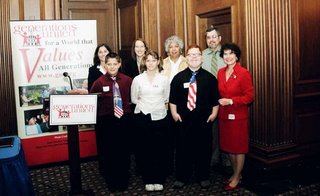 My have feet have hardly touched the ground since I last posted. I have been in Arizona meeting with developers and scoping out a site for a video shoot, in Iowa speaking at a conference, and in California helping to think through a project to build new, livable, multigenerational communities.
And in between, I moderated GU’s own Hill briefing on subsidized guardianship! Here’s a picture of our terrific panel – thanks to Senators Clinton and Snowe we were in the Capitol Building in a room right by the Senate Chamber.
The photo was taken by Mike Patterson – thanks Mike! Our three speakers, Leslie Cohen (University of Illinois at Urbana-Champaign), Amy Miller (Juvenile Rights Project Inc) and Charlotte Price are along the back. Charlotte’s standing next to her husband, Glenn, and their grandchildren are standing in front with me. It was fantastic to hear Charlotte’s moving story – you can read it along with a host of others, here.
If you want more detail, all the materials are available online. And we even have an audio file of the meeting – I’ll warn you in advance it’s a whopping 58MB – if you want to experience the whole thing! E-mail if you’d like a copy.
My visit to California was also really inspiring. It’s a great example of how we’re moving forward as a society and (I hope) learning to plan for a multigenerational future. I was speaking with a team who are working together to plan for some new, truly livable communities – and that means including people from every generation. This isn’t the kind of thing that happens overnight – in fact it’s going to take them 20 years! It’s very exciting to be in at the beginning of such a great project.
Let me know what you think. What do you think planners and developers should consider when they want to build multigenerational communities?
Wednesday, November 29, 2006
On Air
I had the very great pleasure of joining Mark Steiner of WYPR in Baltimore for his flagship public affairs program yesterday. The show should be available in his archive soon. We talked about grandfamilies – specifically grandparents raising grandchildren. 2.4 million children are being raised solely by their grandparents or other relatives. These grandparents are keeping families together and deserve our full support. Dr. Fred Strieder, who directs Baltimore's Family Connections, and two wonderful grandmothers from his program were featured on the show. They all did a terrific job of shedding light on the sacrifices grandparent caregivers make and the love they surround their grandchildren with. It was an honor to be on the show and a privilege to share the microphones with some wonderful partners.
While I was on my way to Baltimore, Jaia was speaking at a conference on subsidized guardianship and other help for grandparents raising grandchildren in Hartford, CT, co-sponsored by GU, AARP Connecticut and the Connecticut Commission on Children. The conference was incredibly well attended, and well organized by AARP Connecticut. This great preview in the Hartford Courant also meant that some extra relative caregivers showed up on the day to learn more and make those all important connections with others in similar situations.
Let us know if you are holding an intergenerational event, and I’ll mention it in our electronic newsletter or in this blog!
While I was on my way to Baltimore, Jaia was speaking at a conference on subsidized guardianship and other help for grandparents raising grandchildren in Hartford, CT, co-sponsored by GU, AARP Connecticut and the Connecticut Commission on Children. The conference was incredibly well attended, and well organized by AARP Connecticut. This great preview in the Hartford Courant also meant that some extra relative caregivers showed up on the day to learn more and make those all important connections with others in similar situations.
Let us know if you are holding an intergenerational event, and I’ll mention it in our electronic newsletter or in this blog!
Monday, November 27, 2006
After the Election
I hope you’ve all had a chance to digest the mid-term election results. In case you missed it (!) NPR has a great election special. I know some people are already looking past the “lame duck” session to next year, when the 110th Congress is sworn in. But there’s still a lot of work to be done in the 109th!
During the “lame duck” session, there are tax-reliefs to extend and programs to pay for. It’s looking likely that Congress will pass a short continuing resolution, allowing federal programs to continue through the holiday season. The continuing resolutions are vital: without them, federal program funding would simply stop. (It’s not likely to happen. No-one wants to see families go without during the holiday season.) The so-called tax extenders are also important, although they’ve gotten less press coverage than the spending measures: they include the deductibility of state and local sales taxes, college tuition and fees, and classroom supplies.
While the 109th Congress winds down, we need to thank some of our good friends – friends like Sen. Mike DeWine of Ohio, who lost his seat November 7th. Senator DeWine has been an incredible supporter of children and grandfamilies, and we’ll miss him and his terrific aide Karla Carpenter. He was, along with Senators Kennedy, Mikulski and Jeffords, one of the key reasons grandfamilies are included in the National Family Caregiver Support Program. I wish him, and his nine grandchildren, all the very best for the future. I’d also like to wish Senator Jim Jeffords the very best: he is retiring from the United States Congress in which he served Vermont for 32 years, 14 in the House and 18 in the Senate.
We look forward to welcoming some new friends, as well as welcoming longtime friends to new roles, when Congress reconvenes in January. I was delighted to read in the Washington Post that Congresswoman Nancy Pelosi was more concerned about the birth of her sixth grandchild, than a congratulatory call from the White House. Congratulations also go to Senator Kent Conrad, who was raised by his grandparents, and has been selected to chair the Senate Budget Committee.
This was a very close election in many districts. One race was won by only 91 votes. It shows how important it is that we all let our voices be heard and vote. What do you think?
During the “lame duck” session, there are tax-reliefs to extend and programs to pay for. It’s looking likely that Congress will pass a short continuing resolution, allowing federal programs to continue through the holiday season. The continuing resolutions are vital: without them, federal program funding would simply stop. (It’s not likely to happen. No-one wants to see families go without during the holiday season.) The so-called tax extenders are also important, although they’ve gotten less press coverage than the spending measures: they include the deductibility of state and local sales taxes, college tuition and fees, and classroom supplies.
While the 109th Congress winds down, we need to thank some of our good friends – friends like Sen. Mike DeWine of Ohio, who lost his seat November 7th. Senator DeWine has been an incredible supporter of children and grandfamilies, and we’ll miss him and his terrific aide Karla Carpenter. He was, along with Senators Kennedy, Mikulski and Jeffords, one of the key reasons grandfamilies are included in the National Family Caregiver Support Program. I wish him, and his nine grandchildren, all the very best for the future. I’d also like to wish Senator Jim Jeffords the very best: he is retiring from the United States Congress in which he served Vermont for 32 years, 14 in the House and 18 in the Senate.
We look forward to welcoming some new friends, as well as welcoming longtime friends to new roles, when Congress reconvenes in January. I was delighted to read in the Washington Post that Congresswoman Nancy Pelosi was more concerned about the birth of her sixth grandchild, than a congratulatory call from the White House. Congratulations also go to Senator Kent Conrad, who was raised by his grandparents, and has been selected to chair the Senate Budget Committee.
This was a very close election in many districts. One race was won by only 91 votes. It shows how important it is that we all let our voices be heard and vote. What do you think?
Thursday, July 13, 2006
The Land Down Under
G’day mates! Several of us at GU have just returned to the states after 5 days in beautiful Melbourne Australia attending the International Consortium for Intergenerational Programmes (ICIP) 2006 conference. It was a terrific event that got us more excited than kangaroo s up a tree!
First off I am honored to have be en elected and to serve as the ICIP Chair for the next four years. I know that everyone on the ICIP management committee looks forward to setting an agenda that will continue to strengthen the international presence of intergenerational programs. Of course we can’t do it with you. Please visit ICIP online at (www.icip.cswebsites.org/default.aspx) to download the latest newsletter, learn about upcoming global, regional, and national conferences, and show your support by becoming a member and sharing articles in future newsletters .
Thanks to the conference sponsors , in particular Susan Feldman for her outstanding leadership, and those who volunteered their time to make this event go so well. I also want to express my gratitude to everyone who presented and attended the conference , especially those that traveled from all over the globe to be there. I’m proud to report that we had representatives from a dozen nations. Each country brought their unique approach to developing and sustaining intergenerational programs.
What is happening where you live? Is there a program that builds bridges between cultures or across borders? Tell me about it!

First off I am honored to have be en elected and to serve as the ICIP Chair for the next four years. I know that everyone on the ICIP management committee looks forward to setting an agenda that will continue to strengthen the international presence of intergenerational programs. Of course we can’t do it with you. Please visit ICIP online at (www.icip.cswebsites.org/default.aspx) to download the latest newsletter, learn about upcoming global, regional, and national conferences, and show your support by becoming a member and sharing articles in future newsletters .
Thanks to the conference sponsors , in particular Susan Feldman for her outstanding leadership, and those who volunteered their time to make this event go so well. I also want to express my gratitude to everyone who presented and attended the conference , especially those that traveled from all over the globe to be there. I’m proud to report that we had representatives from a dozen nations. Each country brought their unique approach to developing and sustaining intergenerational programs.
What is happening where you live? Is there a program that builds bridges between cultures or across borders? Tell me about it!
Monday, June 05, 2006
Foster Care
An ABC/Time magazine poll reveals substantial concern for state foster care systems and public support for reforms to the system. According to the poll, nearly half of Americans feel the system isn’t doing enough for the vulnerable children living in foster care. Generations United and other groups have highlighted the fact that many children in foster are being taken care of by grandparents and relatives but these families don’t have the financial and legal support that other foster care families get. The need for policies like subsidized guardianships for these caregivers could help improve the lives of the more than 20,000 children who live with grandparents and other relatives in foster care.
There are currently more than 500,000 children in our nation’s foster care system. About a quarter of these children live with relative caregivers in grandfamilies. For some of these children, subsidized guardianship could be the only viable option for exiting the system. This option permanently places a child with a grandparent or other relative who can provide a positive and nurturing home environment and becomes the legal guardian. At the same time, the guardian receives financial resources, just as foster families do, that make it possible to provide for the child’s basic needs. In its landmark report, Fostering the Future, the Pew Commission on Children in Foster Care recommended that federal guardianship assistance be provided “to all children who leave foster care to live with a permanent legal guardian.”
More than a quarter of the children and youth in foster care are being raised by relatives. For these kids the availability of subsidized guardianship could mean the difference between a safe permanent home and languishing for years in the system.
GU recently released a report titled Every Child Deserves a Loving Home, which provides state by state data on the number of children living in relative foster care. The first of its kind report is available at http://www.gu.org/. The report explains that allowing states to use federal Title IV-E foster care funds for subsidized guardianship would make permanent homes possible for thousands of children in need across the U.S.
GU will be co-sponsoring a Capitol Hill briefing on June 8th at 10:00a.m. around one of the biggest reasons for children having to be raised by relatives—substance abuse. The briefing, being held in room 138 of the Dirkson Senate Office Building will focus specifically on the impact of methamphetamines on foster care and highlight recommendations for improving the child welfare system.
There are currently more than 500,000 children in our nation’s foster care system. About a quarter of these children live with relative caregivers in grandfamilies. For some of these children, subsidized guardianship could be the only viable option for exiting the system. This option permanently places a child with a grandparent or other relative who can provide a positive and nurturing home environment and becomes the legal guardian. At the same time, the guardian receives financial resources, just as foster families do, that make it possible to provide for the child’s basic needs. In its landmark report, Fostering the Future, the Pew Commission on Children in Foster Care recommended that federal guardianship assistance be provided “to all children who leave foster care to live with a permanent legal guardian.”
More than a quarter of the children and youth in foster care are being raised by relatives. For these kids the availability of subsidized guardianship could mean the difference between a safe permanent home and languishing for years in the system.
GU recently released a report titled Every Child Deserves a Loving Home, which provides state by state data on the number of children living in relative foster care. The first of its kind report is available at http://www.gu.org/. The report explains that allowing states to use federal Title IV-E foster care funds for subsidized guardianship would make permanent homes possible for thousands of children in need across the U.S.
GU will be co-sponsoring a Capitol Hill briefing on June 8th at 10:00a.m. around one of the biggest reasons for children having to be raised by relatives—substance abuse. The briefing, being held in room 138 of the Dirkson Senate Office Building will focus specifically on the impact of methamphetamines on foster care and highlight recommendations for improving the child welfare system.
Wednesday, April 19, 2006
Older Americans Month
Older Americans Month is coming up quickly. It's also Foster Care Month so it's a great time to bring attention to the important role older adults play in the lives of young people whether as primary caregivers, mentors or simply good friends, older adults can provide important connections for young people as they grow to adulthood.
The third week of May is also Intergenerational Week founded by Fred Ramstedt more than 15 years ago. What will you be doing to celebrate and bring attention to the important connection between young and old?
The third week of May is also Intergenerational Week founded by Fred Ramstedt more than 15 years ago. What will you be doing to celebrate and bring attention to the important connection between young and old?
Tuesday, February 28, 2006
Boomers: The Real Greatest Generation?
The Washington Post published a piece on February 19th titled Boomers: The Real Greatest Generation. What follows is a letter I wrote to The Washington Post in response to this piece. What do you think?
I take offense to Leonard Steinhorn’s recent opinion piece titled Boomers: The Real Greatest Generation. As the Executive Director of an organization whose mission is to ‘create a world that values all generations’ I feel this type of intergenerational warfare is counterproductive. We are all different pieces to a puzzle that is the greatest generation.
It is up to older adults to provide the care and guidance to encourage young people to change the world. The children and youth in turn provide the inspiration to the seniors to keep fighting the good fight and to not give up hope.
Thomas Jefferson said, “Each generation imagines itself to be more intelligent than the one that went before it, and wiser than the one that comes after it.” A case for the Greatest Generation could certainly be made for Jefferson, Washington, Madison, Hamilton, and the other revolutionaries. Don’t get me wrong, Woodstock was cool, but the Bill of Rights is pretty high on the list.
Mr. Steinhorn’s stereotype of the World War II and the Korean Conflict generation’s as being racist and homophobic is unfair. In addition to the brave and important work they did in their youth, this generation has committed tens of thousands of hours of volunteer time with a diverse population of children and youth in schools and community centers all across America. There are many in this age bracket who continue to work to make the world a better place despite their advancing age.
The boomers will pick up this benevolent torch and continue with what has been an outstanding contribution to our society as all 80 million strong begin to leave the traditional workforce. There is a stereotype of the Boomers as having sold out to corporate America following the dawn at Woodstock. It is up to them to inspire young people with the skills learned from Martin Luther King, JR., the marches on Washington, and the moon landing. Who knows? You may even learn something about your own prejudices in the process.
I take offense to Leonard Steinhorn’s recent opinion piece titled Boomers: The Real Greatest Generation. As the Executive Director of an organization whose mission is to ‘create a world that values all generations’ I feel this type of intergenerational warfare is counterproductive. We are all different pieces to a puzzle that is the greatest generation.
It is up to older adults to provide the care and guidance to encourage young people to change the world. The children and youth in turn provide the inspiration to the seniors to keep fighting the good fight and to not give up hope.
Thomas Jefferson said, “Each generation imagines itself to be more intelligent than the one that went before it, and wiser than the one that comes after it.” A case for the Greatest Generation could certainly be made for Jefferson, Washington, Madison, Hamilton, and the other revolutionaries. Don’t get me wrong, Woodstock was cool, but the Bill of Rights is pretty high on the list.
Mr. Steinhorn’s stereotype of the World War II and the Korean Conflict generation’s as being racist and homophobic is unfair. In addition to the brave and important work they did in their youth, this generation has committed tens of thousands of hours of volunteer time with a diverse population of children and youth in schools and community centers all across America. There are many in this age bracket who continue to work to make the world a better place despite their advancing age.
The boomers will pick up this benevolent torch and continue with what has been an outstanding contribution to our society as all 80 million strong begin to leave the traditional workforce. There is a stereotype of the Boomers as having sold out to corporate America following the dawn at Woodstock. It is up to them to inspire young people with the skills learned from Martin Luther King, JR., the marches on Washington, and the moon landing. Who knows? You may even learn something about your own prejudices in the process.
Friday, January 27, 2006
Gilbert seniors demand center of their own
You may have read the article we linked to in Generations This Week (you can also click on the headline directly above) about the Gilbert, Arizona seniors who are requesting a senior center of their own - no children allowed. While we agree that seniors deserve private time, Generations United opposes the idea of spending tax dollars to segregate the generations in publicy-owned spaces.
There are numerous alternatives to the "all or nothing" approach, including scheduling time slots for age-specific activities or designating "age zones" within the structure. We challenge persons opposed to these ideas to think back to their childhoods and remember the influence some adult had on their upbringing. It would be a shame for young people to miss out on the joy, experience, and wisdom that seniors have to share. Perhaps more worrisome, for those same young people to develop negative attitudes about the aging process.
We encourage the residents of Gilbert to engage in dialogue about what they want their community to look like. GU is a resource to towns like Gilbert across our country who grapple with these issues. Our How-to Guide on Starting and Strengthening Intergenerational Shared Site Programs is a publication that can help inform the dialogue.
Stay tuned and let's find out what Gilbert decides!
There are numerous alternatives to the "all or nothing" approach, including scheduling time slots for age-specific activities or designating "age zones" within the structure. We challenge persons opposed to these ideas to think back to their childhoods and remember the influence some adult had on their upbringing. It would be a shame for young people to miss out on the joy, experience, and wisdom that seniors have to share. Perhaps more worrisome, for those same young people to develop negative attitudes about the aging process.
We encourage the residents of Gilbert to engage in dialogue about what they want their community to look like. GU is a resource to towns like Gilbert across our country who grapple with these issues. Our How-to Guide on Starting and Strengthening Intergenerational Shared Site Programs is a publication that can help inform the dialogue.
Stay tuned and let's find out what Gilbert decides!
Monday, January 16, 2006
MLK Jr Holiday
Extending wishes for a meaningful Martin Luther King, Jr. holiday. In the tradition of Dr. King, we dream of and strive to help create a world that values and engages all generations.
Subscribe to:
Posts (Atom)