Wednesday, December 03, 2014

Grand Canyon National Park With Your Grandchild: Colorado River Rafting and a Historic Train Ride

EDITOR’S NOTE: Each week, we feature intergenerational program ideas that were tried and successful. This series is a tool to highlight various age-optimized programs and practices. The program descriptions are provided by representatives of the programs. Inclusion in this series does not imply Generations United’s endorsement or recommendation, but rather encourages ideas to inspire other programs.


Colorado River Rafting and a Historic Train Ride is among the 5,500 intergenerational educational tours Road Scholar offers in all 50 states and 150 countries.
Alongside local and renowned experts, grandparents and grandchildren experience in-depth and behind-the-scenes learning opportunities, from cultural tours and study cruises to walking, biking and more.
At the Grand Canyon National Park adventure, all ages raft the Colorado River beneath towering 800-foot sandstone cliffs, free fall to the “Giant Swing” and enjoy a two-hour train ride to the South Rim of Grand Canyon National Park.

Got something cool you tried that was successful? Why not tweet your cool intergenerational ideas to #cooligideas? You can also post them to ourIntergenerational Connections Facebook Group or just text us through the FacebookMessenger app (friend me to join our Cool Intergenerational Ideas group discussion). We want to highlight innovative age-optimized programs and practices through our blog, social media and weekly e-newsletter! Share the inspiration.

Tuesday, November 18, 2014

K-9 Healers Intergenerational Pet Therapy Project

EDITOR’S NOTE: Each week, we feature intergenerational program ideas that were tried and successful. This series is a tool to highlight various age-optimized programs and practices. The program descriptions are provided by representatives of the programs. Inclusion in this series does not imply Generations United’s endorsement or recommendation, but rather encourages ideas to inspire other programs.

In part 24 of our series, we feature the K-9 Healers Intergenerational Pet Therapy Project, which is based in Branchport, NY.

(Check our archives for parts 1-23.)

Since 1995 the K-9 Healers Intergenerational Pet Therapy Project or “K-9 Kids” has been a project that brings together youth, residents of the Homestead Long Term Care Facility, and registered Pet Therapy dogs.

Gail Furst founded this program in 1995 with her registered Pet Therapy Boxer, “Rosie”, and one child visiting the Homestead room to room.

The program gives youth the opportunity to develop safe, caring relationships with the senior citizens while at the same time taking pride in their work as dog handlers and helpers.

The youth come to the after-school program every Wednesday during the school year. They arrive at the Homestead, join the three facilitators and gather in a common room to talk about their day.

Once everyone has had a chance to relax they go and join the residents in their activity room to participate in an intergenerational craft project. 

During the program the youth share who gets to take care of the dogs, as well as helping some of the residents cut paper, glue, and finish their art project. Throughout the program the youth are showered with praise by the facilitators as well as the residents.

The K-9 Kids goals include enhancing each participant’s use of personal power through learning how to control a dog in a nursing home; providing human and canine companionship to nursing home Residents; promoting each participant’s ability to use self-control; increasing each participant’s self esteem, empathy, patience, and positive sense of self-worth; teaching the participant’s how to praise and providing them with opportunities to receive praise from facilitators, residents, and each other.

The program also teaches the children reverence for life.

K-9 Kids is a program funded by Yates County Community Services, which distributes funds to the Rushville Health Center, where Ms. Furst was the Outreach Department Director for over 15 years.

To date the K-9 Kids has serviced over 1000 youth living in Yates County.

The K-9 Kids Project has been nationally recognized twice. The first was when it was listed by the Humane Society of the United States directory of Animal-Related Programs for Violence Prevention and Intervention (www.hsus.org).

The second recognition was by America’s Promise in 2000. America’s Promise is a campaign founded by General Colin Powell (www.americaspromise.org).

K-9 Kids was highlighted as a program that brings youth into Finger Lakes Health, with which the Homestead is affiliated.

Got something cool you tried that was successful? Why not tweet your cool intergenerational ideas to #cooligideas? You can also post them to ourIntergenerational Connections Facebook Group or just text us through the FacebookMessenger app (friend me to join our Cool Intergenerational Ideas group discussion). We want to highlight innovative age-optimized programs and practices through our blog, social media and weekly e-newsletter! Share the inspiration.

Monday, November 10, 2014

Holidays are not always merry and bright

by Jaia Peterson Lent

as published in GRAND Magazine

Conner stood attentively at the screen door, his bright brown eyes fixed on the street in front of his grandmother's house, his hands clutching a clay figurine of a turkey he had made for his mom. She had promised to come for Thanksgiving dinner.

“One slice of turkey, three peas, two helpings of mashed potatoes, five books, and four rounds of Crazy Eights later, Connor was still waiting. “It’s bedtime,” his grandmother said, “How about we change into our pj’s and watch your favorite show?”

“No,” Connor shouted, “I want to watch it with Mommy!” Within minutes, his hurt feelings escalated to full-blown tantrum.

Three hours later, Conner was finally asleep, his head resting on his Grandpa's lap. His grandmother gently slid the clay turkey figurine out of Conner's hand, and covered him and his sleeping Grandpa with a blanket. Only then could she breathe a little easier.

Meeting the challenges that come with holidays

This time of year, more than 2.7 million grandparents raising grandchildren find themselves navigating a unique set of holiday stressors. Not only do they have to prepare their grandchildren for the possibility that the children’s parents won’t show up—they have to steel themselves to weather the fallout, all while simultaneously juggling their own loss, grief, anger, and confusion related to the reasons their adult child is not able to care for their grandchild.

Despite the gaiety one hopes to experience during the holidays, grandchildren not living with their parents often feel a mixture of joy, anxiety, excitement, and sadness. No matter their age, grandchildren may not know how to deal with the emotional swings that come with disappointment, or even with pleasant surprises. What you need is a GRANDfamily strategy!

Manage the children’s expectations: If you know that their parents will not be participating in any way during the holiday celebrations, gently tell your grandchildren ahead of time. That way, if the parents show up or send a present, it’s far easier to share the good news. If the parents don’t show, it may soften the blow and help them avoid feeling forgotten or ignored.

Support the child’s desire to give: Children love their parents, even when they have been hurt by them. It’s important to let them express how they feel. During holidays, this may come through giving. Even if you fear it won’t be reciprocated, it’s important to help them find joy in giving.

Keep it simple: You can’t be everything to everyone. Figure out the few key people that your grandchildren need to see over the holidays and focus on making those gatherings the best they can be.

Create your own traditions: Children need routine, tradition, and rituals. When they had to leave mom and/or dad's home, the rituals they had were interrupted. Holidays are a terrific time to introduce some new fun traditions that don’t revolve around parents.

Jaia Peterson Lent is the Deputy Executive Director at Generations United, a national organization dedicated to improving the lives of children, youth and older people through intergenerational collaboration, public policy and programs. Home to the National Center on Grandfamilies, Generations United is a leading voice for issues affecting families headed by grandparents or other relatives.

Wednesday, November 05, 2014

Tom's Take on the Ebola Outbreak

Tom Taylor with his grandson
History offers a vicarious experience. It allows young people to possess the ground equally with their elders. However, without a knowledge of history to give them a context for present events, the youth are at the mercy of every social misdiagnosis handed to them.

The English author, Hilary Mantel's, words ring true today. The social misdiagnosis, or misinformation, of our time includes these myths about Ebola:

1. Ebola clinics give patients injections that kill them faster

2. Schools are using routine blood tests and vaccinations to infect children with Ebola

3. Health officials are spreading the Ebola virus.


And the list goes on. 

In his guest post, Mr. Thomas C. Taylor, retired Senior Advisor for Generations United’s Seniors4Kids initiative, pulls from his 80-plus years of wisdom to offer a historical context for present events. 

Here’s Mr. Tom Taylor:

If you've been following the news, then you know the Ebola outbreak has overtaken the headlines.

The possible state quarantines and public fear of both Ebola survivors and doctors are enough to make you think we’re living the last days – as if we didn’t live through Polio, Yellow Fever and AIDS.

The Ebola scare today is as heightened as it was for polio, once the most feared disease worldwide.

It killed President Franklin D. Roosevelt in 1945. Seven years prior, the U.S. established the National Foundation for Infantile Paralysis, which we know today as The March of Dimes.

I remember the symbolic gesture of my classmates and I, when we marched through our school’s assembly hall and dropped a dime in a basket.

I was a teenager then, living in New Haven, CT. The crippling disease was the Ebola of our time.

The misinformation made people think the crippling disease spread through coughs and sneezes.

Three years after Roosevelt’s death, Dr. Jonas Salk, whose birthday Google recognized last week with a Doodle, developed the first vaccine delivered by injection.

And despite advice to get the shot, many people refused to do so.

The public fear of Polio lasted until 1961, when Dr. Albert Sabin developed an oral vaccine, from which my two children benefitted.

Unfortunately, there is no vaccine for HIV/AIDS, which arrived in the U.S. in the late 1960s.

The misinformation led the Centers for Disease Control and Prevention to report it first as a disease between gay men.

Since then, those claims have been corrected. AIDS hit many famous people including movie star Rock Hudson, who died in 1985.

Countering misinformation today might require us revisiting creative solutions from the past.

With AIDS, a creative solution was the first World AIDS Day in 1988 – the same year tennis legend Arthur Ashe and Magic Johnson, a basketball great, announced they were HIV-positive.

Both men helped raise awareness.

Ashe’s autobiography, in which he stated catching AIDS from a blood transfusion, prompted better screening of blood banks.

Magic Johnson is an inspiration to people living with HIV by not letting the disease stop him from living a successful life.

Tom at a Seniors4Kids event.
He’s now part owner of the Los Angeles Dodgers baseball team and owner of the Magic Johnson Theater chain.

Another creative solution to misinformation used the arts to raise awareness of Yellow Fever in a fun way.

I was in first grade when I learned about the Yellow Fever epidemic through a play.

In fact, I played the part of Dr. Carlos Finlay, who, with help from Dr. Walter Reed, developed a cure in 1900.

Finlay, who became a hero when my mom was a child, did this after learning the disease was transmitted by mosquitos.

In addition to being a success, the play taught me the importance of helping people. This impacted how my professional life unfolded, working on behalf of children, youth and families.

Tuesday, November 04, 2014

Building Bridges

EDITOR’S NOTE: Each week, we feature intergenerational program ideas that were tried and successful. This series is a tool to highlight various age-optimized programs and practices. The program descriptions are provided by representatives of the programs. Inclusion in this series does not imply Generations United’s endorsement or recommendation, but rather encourages ideas to inspire other programs.

In part 23 of our series, we feature Building Bridges, a program of the University of Missouri Extension.

(Check our archives for parts 1-22.)

Building Bridges is a community-based intergenerational program to help bring generations together for meaningful interactions and experiences.

Education, friendship, and caring are major components. The program evaluation results showed that Building Bridges not only helped young generations practice character traits, but also have more positive perceptions of growing old.

The majority of children and youth from Building Bridges felt that they showed their caring, respect and sharing with older adults and made older adults happy and less lonely.

Through the program, both generations have a better understanding of each other and their comfort zone for conversation and sharing was enhanced.

Got something cool you tried that was successful? Why not tweet your cool intergenerational ideas to #cooligideas? You can also post them to ourIntergenerational Connections Facebook Group or just text us through the FacebookMessenger app (friend me to join our Cool Intergenerational Ideas group discussion). We want to highlight innovative age-optimized programs and practices through our blog, social media and weekly e-newsletter! Share the inspiration.

Tuesday, October 21, 2014

Our Folks

EDITOR’S NOTE: Each week, we feature intergenerational program ideas that were tried and successful. This series is a tool to highlight various age-optimized programs and practices. The program descriptions are provided by representatives of the programs. Inclusion in this series does not imply Generations United’s endorsement or recommendation, but rather encourages ideas to inspire other programs.

In part 22 of our series, we feature Our Work, a program of Groundwork Hudson Valley.

(Check our archives for parts 1-21.)

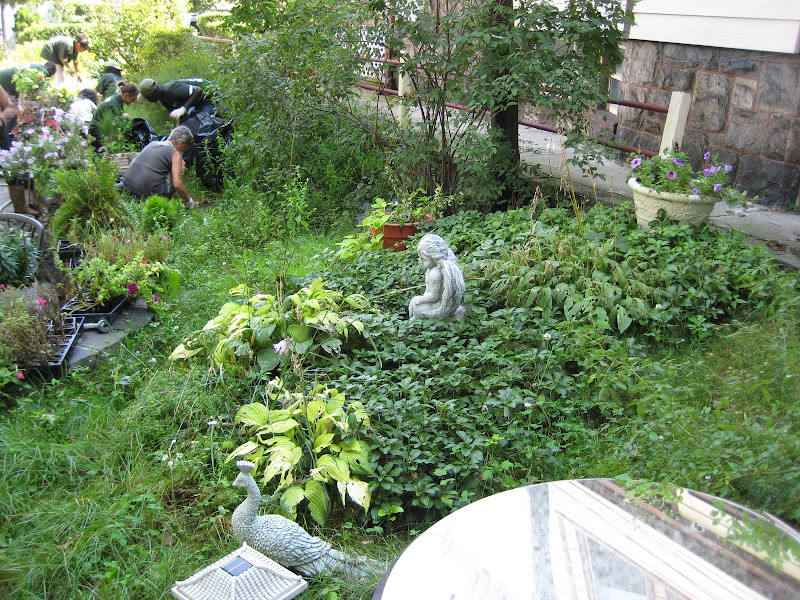
Launched in the fall of 2008, Our Folks aims to get youth involved in efforts to help older adults in their community age in place.

To do this, the team, comprised of students from Riverside High School, interviewed a number of older adults to find people who still live in their homes and need help maintaining them.

Groundwork staff and local professionals taught the students landscaping and home repair skills like tree-pruning, painting, weeding, planting, lawn-mowing, etc. enabling them to work with the home-owners to make needed repairs.

The second goal of this program is to bridge the generation gap by bringing people together over shared projects and shared lunches! 

The students and homeowners prepare meals together and spend time getting to know each other over lunch. Our first year with this project proved that very meaningful relationships can come out of this interaction, and that there is much to be learned on both sides.

Primary funding for this program is provided by the United Way of Westchester and Putnam and the Helen Andrus Benedict Foundation.

Additional funding is provided by the Westchester County Youth Bureau, St. Faith’s House Foundation, and the Thomas & Agnes Carvel Foundation.

Got something cool you tried that was successful? Why not tweet your cool intergenerational ideas to #cooligideas? You can also post them to our Intergenerational Connections Facebook Group or just text us through the Facebook Messenger app (friend me to join our Cool Intergenerational Ideas group discussion). We want to highlight innovative age-optimized programs and practices through our blog, social media and weekly e-newsletter! Share the inspiration.

Monday, October 20, 2014

2014 Eisner Prize Winners Part 2 - The Intergenerational Schools

For 14 years, The Intergenerational Schools (TIS) have been a transformative model of lifelong learning positively impacting costs and outcomes associated with educating children and engaging older adults, including those with dementia.

Based on its success and community interest, there are now three Intergenerational Schools operating in Cleveland, providing a free public education to over 500 young learners.

Co-founder Peter Whitehouse, Ph.D., recently announced the creation of Intergenerational Schools International (ISI) and its first project The Intergenerativity Project (TIP). (Learn more about ISI and TIP.)

The Intergenerational Schools feature an innovative kindergarten through 8th grade developmental curriculum that is proven to foster student achievement. Modeled on building relationships of reciprocal respect and learning, multi-age classrooms give every child the opportunity to serve as both teacher and learner.

Classes have a range of ages (spanning 3-4 years) and abilities, creating a dynamic and individualized learning environment.

Additionally, students learn with a lifespan perspective and benefit from daily interactions with a diverse group of adults and elders who participate fully in the school community as mentors, tutors, and co-learners.

TIS actively partners with Judson Smart Living and Case Western Reserve University not only to deliver their programs, but also to document and study them for potential future replication. Learn more about The Intergenerational Schools.

2014 Eisner Prize Winners Part 1 - Bridge Meadows

Congrats to our friends, Bridge Meadows and The Intergenerational School, on winning the 2014 Eisner Prize!

Last week, we started profiling each organization. Here's Bridge Meadows.

A unique multi-generational community (located in the Portsmouth neighborhood of North Portland, OR), Bridge Meadows is a place where adoptive parents, foster children, and low-income elders - those over 55 - find a true home built with love and the shared vision of a better tomorrow.

Children move from the instability of foster care placements to permanent homes and families. Adoptive families receive essential resources and guidance, and low-income elders find purpose as they volunteer 100 hours/quarter in service to the community.

These services are why The Eisner Foundation recognized Bridge Meadows for the "Innovation in Intergenerational Solutions" category. Learn more about Bridge Meadows. Stay tuned when we profile The Intergenerational School.

Tuesday, October 14, 2014

Generations of Us: An Intergenerational Storytelling Project

EDITOR’S NOTE: Each week, we’ll feature intergenerational program ideas that were tried and successful. This series is a tool to highlight various age-optimized programs and practices. The program descriptions are provided by representatives of the programs. Inclusion in this series does not imply Generations United’s endorsement or recommendation, but rather encourages ideas to inspire other programs.

In part 21 of our series, we feature Generations of Us, an intergenerational storytelling project in Chicago, IL.


Generations of Us: An Intergenerational Storytelling Project on Chicago’s South Side connected young and older adults living on Chicago’s South Side to share their personal experiences through oral history interviews.

The project aimed to use the power of storytelling to promote intergenerational reconciliation and learning between young and older adults living in communities impacted by poverty, violence, and the criminal justice system.  

The project rested on the idea that intergenerational dialogue will promote peace by creating understanding and stronger networks within the community.

Through a partnership with the South Side Help Center in Chicago's Roseland community and the Atlas Senior Center in the South Chicago neighborhood, the young and older adults participated in interactive workshops focusing on the power of storytelling to hear firsthand accounts of history, share life experiences and perspectives, combat ageism, build relationships, and promote intergenerational dialogue.

The project took place during the month of August 2014 and included 8 workshops. It began with a one-day workshop that introduced oral history and including an interactive aging simulation with the young people at the South Side Help Center.

The remaining workshops took place at the Atlas Senior Center, which allowed the young adults to visit the Senior Center each day.

The curriculum followed the 6-step process of Oral History: plan, prepare, exchange, preserve, present, and reflect.

To ensure that the participants would be able to interact as much as possible, workshops incorporated intergenerational activities, icebreakers, games, practice interviews, and lessons on the process of oral history each day.

On average, 25 participants attended each day, and we typically had a ratio of one older adult to two young adults. In total,  approximately 50 participants attended and recorded 10 full-length oral history interviews.

The last day of the workshop was a presentation and celebration that was open to the public, which included playing short selections from the interviews, participants sharing their personal reflections, playing BINGO, and eating delicious food!

Each participant received a t-shirt and a CD with their audio recording and approximately 50 people were in attendance for the celebration! Due to the success of this project, future collaborations between the South Side Help Center and the Atlas Senior Center are in the process of being discussed.

For more information about this project, please take a look at the Generations of Us blog and/or contact Kelli Bosak directly at kbosak@uchicago.edu.

Kelli Bosak is a graduate student at the University of Chicago’s School of Social Service Administration.  

This project was made possibly by a grant from the Kathryn W. Davis Projects for Peace through the International House of Chicago.

Got something cool you tried that was successful? Why not tweet your cool intergenerational ideas to #cooligideas? You can also post them to our Intergenerational Connections Facebook Group or just text us through the Facebook Messenger app (friend me to join our Cool Intergenerational Ideas group discussion). We want to highlight innovative age-optimized programs and practices through our blog, social media and weekly e-newsletter! Share the inspiration.

Monday, October 13, 2014

Multigenerational Housing in an Expensive Locale Part 2 - Solutions

This post appears courtesy of Brandon Baunach, an architect with 17 years of experience.

In my previous post, I shared the challenges of finding affordable multigenerational (multigen) housing when my wife and I decided to buy a house with my mother. (You can read about it here.)

Over the next several posts, I’ll explore solutions for multigen housing in dense urban environments – like New York and San Francisco – concerning unit and project design, project finance, and project planning issues. 

I’ll start by exploring broad design considerations – a family’s privacy, willingness to share and responsibility – that help guide successful projects when building multigen housing.

Privacy

Apartments in dense urban settings are generally smaller than those in suburban communities. Because of this, creating higher levels of privacy both inside and outside of a unit become challenging.

Here are some questions to understand about the end user: what level of privacy is preferred? What level is acceptable? and What level is unacceptable?

For instance, through local market research, one may find that users of different generations feel comfortable around their family in public areas such as a living room, but require absolute isolation and separation in their use of a bathroom or a kitchen. Other groups may like to share kitchens and not living rooms.

Privacy between a multigen household and other households should also be understood.

Do families prefer to know their neighbors? At what degree do they interact? What level of interaction is acceptable to the different generations?

End users, for example, may find that, although they have deep integration within their own family, they may want to stay private outside of the household.

These issues would certainly inform how public space is designed, if the property is a cooperative or a condominium, how units get individual private spaces or only public spaces or both, and how certain domestic activities are encouraged to be more public such as shared laundry or cooking facilities.

Willingness to Share

Willingness to share is related to, but distinctly different from, privacy. On the surface, a member of a household may not want to share a bathroom. Is this because they are deeply embarrassed to potentially be seen in a compromising position? Or is it because they see their space as the space they, and no one else, owns?

What’s interesting is, once a household member feels like they have a significant sense of ownership, they may be willing to share more than they originally thought. In effect, what a designer might have originally suspected as a need for privacy was actually a need for ownership.

A concrete design example may be a kitchen.

Let’s say a grandparent has to have their own kitchen that is separate from their child’s family’s kitchen.

Why? Is it that the grandparent wants to keep food separate? They don’t like certain smells? They don’t like to be crowded when they cook? Or they cook at odd hours?

What designers may find when digging deeper is that one kitchen will work for two adult generations if an additional refrigerator is added or that the kitchen has a bit more counter space to allow for separation.

Responsibility

Understanding the baseline of family responsibility will be critical in designing a harmonious multigenerational household.

Ultimately, for legal reasons, responsibility of mortgages, rents, and bills, and a household’s relationships with their neighbors has to be settled with one or all parties within a household.

Because of this, multigen developments should create further contractual obligations that provide a clear path for financial and social responsibilities.

In terms of design of a household unit, it’s best to assume that people would prefer to be responsible for as little as possible and will begrudgingly accept responsibility with resentment in return. 

Although this is quite cynical, this allows multigen housing designers the opportunity to provide interesting amenity options that would benefit a household of multiple adult generations.

For instance, imagine a cleaning service that provides periodic cleaning only in shared spaces such as kitchens and laundries. So bedrooms, baths, and living spaces are to the user's discretion, but common spaces always remain clean. Because of the scale and specificity of spaces cleaned, the cost could be quite reasonable.

As you can see, there are many variations and considerations for how you might design a multigenerational household. In my next post, I’ll continue with solutions for multigen housing in dense urban environments, exploring factors like life stages, race and culture, and economic status. 

The design aspects I discussed mostly help with the social stability of a multigenerational household. 

And although economic necessity can dictate the choice of adult generations living together, it does not necessarily have to dictate their sense of individuality and purpose given thoughtful design.

Brandon Baunach is an architect at BAR Architects in San Francisco, CA. He lives in Berkeley, CA, with his wife, mother, and two sons.

The Significance of an Intergenerational Conference Convening in Hawai'i

There are two reasons we’re excited about next year’s international conference. First, will it be the first time we convened a conference outside of D.C. Secondly, it's in Honolulu, Hawai'i!

Our guest blogger, ASN Consulting Services' Audrey Suga-Nakagawa, explains the significance of an intergenerational conference convening in Hawai'i.

Hawai'i is one of the most racially diverse places in the world.  

It has become home to many different ethnic groups over the last 200 years, as each ethnic group has added elements of its own culture to local life. 

Hawai'i's variety of cultures can be traced back to the old “plantation days” in the Islands, when various ethnic groups from all over migrated to Hawai'i to earn a living and support their growing families. 

Today, contemporary culture in Hawai'i is a mix of the different cultures and ethnic groups that make up its unique population.

The State also enjoys one of the longest life expectancy in the nation and the world.  The average 65-year-old woman in Hawai'i today has a life expectancy of 88 years while men can expect to live past 84 years of age.   

Hawai'i’s respect and reverence for its kupuna (Hawaiian for elder, grandparent or older person) deeply rooted in the local culture.  

A kupuna is an honored elder who has acquired enough life experience to become a family and community leader. 

In ancient times, they were teachers and caretakers of grandchildren and that bond was especially strong. Even today, the kupuna is expected to speak out and help make decisions on important issues for both the family and the community. 

Many are actively engaged as volunteers in our schools, hospitals, community service organizations, churches, ethnic and cultural clubs and continue to play a vital role in their multigenerational households. 

Our kupuna show how rich a resource they are and why they should be tapped to contribute to the betterment of Hawai'i, for they truly represent one of Hawai'i's fastest growing natural resources.

The City and County of Honolulu is currently engaged in becoming an internationally recognized Age Friendly City, a prestigious designation by the World Health Organization’s (WHO) Global Network of Age Friendly Cities and Communities.


Tuesday, October 07, 2014

Skokie School District 73.5's Grandfriends Intergenerational Volunteer Program

EDITOR’S NOTE: Each week, we’ll feature intergenerational program ideas that were tried and successful. This series is a tool to highlight various age-optimized programs and practices. The program descriptions are provided by representatives of the programs. Inclusion in this series does not imply Generations United’s endorsement or recommendation, but rather encourages ideas to inspire other programs.

In part 20 of our series, we feature Skokie School District 73.5’s Grandfriends Intergenerational Volunteer Program in Skokie, IL.

(Check our archives for parts 1-19.)

The Grandfriends Intergenerational Volunteer Program is one of the longest, continuously operating, school-based intergenerational programs in Illinois.

The program, which started in 1991, matches local older adult volunteers with kindergarten-fifth grade classrooms. Volunteers, in collaboration with the classroom teachers, work with students in areas of reading, writing and math.

Frequently Grandfriends share their own life experiences, which brings history to life.

Additionally, volunteers have helped in the school office, the library and with the art and music teachers.

The Skokie School District 73.5 is a culturally-diverse community and their Grandfriends help students as they learn to communicate in English. Enduring relationships have developed between teachers, school staff and our wonderful volunteers.

The volunteers love watching the children grow throughout the school year.

Their Grandfriends often serve as "ambassadors at large," sharing the insights they have gained by being in the school throughout the wider community.

Parents, students and school staff have all come to recognize and value the incredible resource their Grandfriends have become.

Got something cool you tried that was successful? Why not tweet your cool intergenerational ideas to #cooligideas? You can also post them to ourIntergenerational Connections Facebook Group or just text us through the FacebookMessenger app (friend me to join our Cool Intergenerational Ideas group discussion). We want to highlight innovative age-optimized programs and practices through our blog, social media and weekly e-newsletter! Share the inspiration.

Tuesday, September 30, 2014

Grandparents Raising Grandchildren of Brevard County, Florida

EDITOR’S NOTE: Each week, we’ll feature intergenerational program ideas that were tried and successful. This series is a tool to highlight various age-optimized programs and practices. The program descriptions are provided by representatives of the programs. Inclusion in this series does not imply Generations United’s endorsement or recommendation, but rather encourages ideas to inspire other programs.

In part 19 of our series, we feature Grandparents Raising Grandchildren of Brevard County, Florida, which was established in 1994.

(Check our archives for parts 1-18.)

Grandparents Raising Grandchildren of Brevard County, FL was founded by a grandmother with a vision to improve conditions for relative care families and the community who care for them.

The mission of GRG of Brevard is to provide advocacy, support, and referral to relative care families throughout Brevard County. Our vision is that one day all children will live in a safe loving home with relatives that will help them to develop into their full potential. Living in a place you can call home and knowing that someone will always be there for you is something everyone needs, especially children.

There are over 8,500 children living in relative care families in Brevard County. Everyday GRG of Brevard receives a call for help from a family in crisis.

The Child First Program creates a menu of services based on the needs of each family that include advocacy, counseling, training, legal and financial assistance, recreational activities, and holiday assistance.

The goal is to ensure permanent placement with relatives in lieu of foster care; address special needs of children being raised by relative caregivers; advocate for relative caregivers and raise awareness of their needs as well as their contribution.

Got something cool you tried that was successful? Why not tweet your cool intergenerational ideas to #cooligideas? You can also post them to our Intergenerational Connections Facebook Group or just text us through the Facebook Messenger app (friend me to join our Cool Intergenerational Ideas group discussion). We want to highlight innovative age-optimized programs and practices through our blog, social media and weekly e-newsletter! Share the inspiration.

Tuesday, September 23, 2014

Tom Taylor’s Grandparents Day Story

Tom with his granddaughter.
This blog post and photo appear courtesy of Tom Taylor, special advisor to Generations United's Seniors4Kids initiative. 

Three days before Grandparents Day, one of my granddaughters called to say she would be coming from her home in Arlington, VA, to where I live in downtown Silver Spring, MD, for a business meeting.

She was appointed to a position on the executive level at a major restaurant when she lived in Florida before her transfer to Arlington over a year ago.

She wanted to drop by after her meeting.

When she first moved back to Arlington, we were in contact on a weekly basis by phone or visits as she helped me with Facebook and computer problems.

Her fiancé from Florida moved in with her about four months ago, and our communications stopped. Rumors about a big wedding began floating through the family.

When she called to say she would be in town, I was excited to see her. She helped me update my Facebook, fixed my computer issues, and then we went to dinner.

At the restaurant, I realized the wedding rumors were true when she told me about her plans, which will include a ceremony this December in the Dominican Republic.

As we talked about the wedding, she became more relaxed and her ebullience lifted both our spirits.

When I told her I would not be able to attend, she said: "I have a special role for you. The event in the Dominican Republic is not the legal ceremony. We will be married in Arlington two days before and I want you to be my escort."

I let her know that I would be honored to have such an important role in her life since her Dad lives in California and will not be able to be here.

We spent nearly two wonderful hours in the restaurant. When the waiter brought the check, she took it and said, "I'm paying. Sunday is Grandfathers Day."

Let us know how you celebrated Grandparents Day so we can possibly share your story through our social media and here, on our Together Blog. If you missed our Grandparents Day awareness-raising campaign, check out highlights. Let's Do Something Grand all year long. Check out GrandparentsDay.org for ideas.

Foster Grandparent Program

EDITOR’s NOTE: Each week, we’ll feature intergenerational program ideas that were tried and successful. This series is a tool to highlight various age-optimized programs and practices. The program descriptions are provided by representatives of the programs. Inclusion in this series does not imply Generations United’s endorsement or recommendation, but rather encourages ideas to inspire other programs.


In part 18 of our series, we feature the Foster Grandparent Program, an initiative of NOrth Coast Opportunities, Inc. in Ukiah, CA.


The Foster Grandparent Program places low income, older adults as tutors and mentors to special needs children in preschools, Head Start Centers, public schools, after school programs like Boys and Girls Clubs, and juvenile detention centers.


Volunteers serve a minimum of 15 to a maximum of 40 hours per week in supervised settings. Pre-service orientation is provided as well as monthly in-service training.


All volunteers receive a criminal history background verification, and an annual physical examination.


The mission of the program is to empower older adults, to promote healthy aging and economic self-sufficiency for low income older adults while tutoring and mentoring special needs children to enhance their physical, mental, emotional and social development.


Classroom teachers assign specific children to each foster grandparent and complete an assignment plan that identifies activities to be completed with each child daily to assist the children to achieve identified goals and objectives in the areas of social, academic and emotional development.


Currently the program provides service in Del Norte, Humboldt, Lake, Mendocino and northern Sonoma counties in northern California. The program is been sponsored by North Coast Opportunities, a community action agency since 1973.

Got something cool you tried that was successful? Why not tweet your cool intergenerational ideas to #cooligideas? You can also post them to our Intergenerational Connections Facebook Group or just text us through the Facebook Messenger app (friend me to join our Cool Intergenerational Ideas group discussion). We want to highlight innovative age-optimized programs and practices through our blog, social media and weekly e-newsletter!  Share the inspiration.

Friday, September 19, 2014

Gloria Estefan: In Her Own Words - Hispanic Heritage Month

My grandmother on my mother's side cared for me from birth, and nurtured the thought that music was a gift I had received. And although I was reluctant to follow that path, I somehow found myself involved with music because our gifts are meant to be shared for the good and pleasure of others. We remained extremely close throughout my life, and even after her death I have often found comfort in her memory and the wisdom she shared with me.

My grandmother always pointed out my strengths and filled me with hope for the future. She constantly nourished my inquisitiveness, and shared many quests for seeking answers to my questions. She wasn't afraid to let me see her vulnerability, and made that intimacy an asset to be celebrated. Primarily through her example, I learned that we, as women, have limitless potential. I finally said yes to music because of her.

The most valuable lessons I learned from my grandmother were to discover what makes you happy, and do it with as much energy and joy as you can muster.