Wednesday, August 20, 2014

Meet Mary Harding - Seniors4Kids Profile

Mary Harding is not one to cower from doing what’s right. She once risked being ostracized when she voted against her colleagues with the Nebraska Public Power District (NPPD) Board of Directors to reject the resolution on TransCanada’s Keystone Pipeline project.

Although NPPD still approved the resolution, Harding became a hero for Bold Nebraska, an advocacy group that continues to fight the pipeline project.

She’s just as determined, when it comes to her grandkids and other young Nebraskans, to leave them a better world. “I hope that they can enjoy the same kind of life that I did growing up,” she said. “We felt safe on the streets…. Schools were well-funded” and better-off then.

Today, nearly 40 percent of Nebraska’s children ages 0-5 aren’t doing as good as Harding’s generation did at their age, according to a data by First Five Nebraska, an advocacy group building public momentum in support of high quality early childhood experiences for young Nebraskans. That preschool group is considered at risk of later failing in school and life because they don’t have access to high-quality early experiences and relationships.

“The more we know about the development of human beings, the more we realize those early experiences are absolutely critical to laying down the pathways that make an individual a good member of our community and society,” Harding said.

Her early experiences helped her appreciate the environment she fights to protect. “I love the change of the seasons,” said Harding, whose preservationist background includes executive director positions at both the Nebraska League of Conservation Voters and the Nebraska Environmental Trust Fund.

Harding’s currently helping to push her state’s wind-energy potential, with NPPD’s goal of generating 10 percent of its power from wind. “I love the fresh air and the clean water that we take for granted here,” she said.

Harding’s early experiences also derive from her Nebraskan roots that run seven generations deep.  She feels that same sense of community in her current hometown, Lincoln, where she and her husband, Richard Erickson, operate a residential rental property business.

With a population of over 302,000, the Lincoln Metropolitan area – which also encompasses Lancaster and Seward counties – is personable enough for Harding’s granddaughters – Eleanor, 5, and Elizabeth,2 – to enjoy the easygoing pace and hospitality their grandmother enjoyed from childhood to now. 

Harding hopes to see more grandparents advocating for children and youth. In her Aug. 23 letter that the Omaha World-Herald published, she called on Nebraska Gov. Dave Heineman to do more with Parental Involvement in Education Month.

“As a grandparent and Nebraskan who cares about our state’s future, I urge the governor to expand that call to grandparents and extended families,” Harding wrote in her piece, “involve grandparents in school family” – noting that educators and childcare providers are already interacting with the one in 10 grandparents who regularly provide care for at least one grandchild.

Since older adults have the benefit of experience,  “we must stand up, speak out and get involved at the very beginning in advocating for children,” according to Harding. “We got to take a role in helping shape the policies that we undertake to provide for a strong environment to raise children.”  

Tuesday, August 19, 2014

Grands As Parents Inc.

PHOTO: Courtesy of Grands As Parents Inc.
EDITOR’s NOTE: Each week, we’ll feature intergenerational program ideas that were tried and successful. This series is a tool to highlight various age-optimized programs and practices. The program descriptions are provided by representatives of the programs. Inclusion in this series does not imply Generations United’s endorsement or recommendation, but rather encourages ideas to inspire other programs.

In part 13 of our series, we feature Grands As Parents Inc., a Philadelphia-based collaborative effort addressing the needs of relative caregivers.

(Read parts 12345678910, 11 and 12)

Grands As Parents Inc. was founded in 1996 and is comprised of grandparent caregivers and relatives who have found themselves in parenting roles for their grandchildren (in some cases great children). These grandparents have been forced from the realm of retirement to become sole caretakers for these energetic and needy children.

Grands As Parents provides support services and advocates for the rights of the heads of such families and is committed to providing assistance to these caregivers and their entire household for which rhey are responsible.

GAP is designed to address the special needs and concerns of the grandparents who have specific issues (whatever the reason) and who are temporary or permanent caretakers of their grandchildren, however this is not a requirement for participation.

This a non-profit organization is administrated by volunteers and has a board of directors. This organization willingly collaborates with other nonprofit community organizations in the concept that it takes a village to raise a child.

GAP provides the following services/ referrals - Crisis/Stress Management, Legal Services, Housing, Food, Clothing, Human Resources.


Got something cool you tried that was successful? Why not tweet your cool intergenerational ideas to #cooligideas? You can also post them to our Intergenerational Connections Facebook Group. Youth Jumpstart Grantees can share ideas here. Or just text us through the Facebook Messenger app (friend me to join our Cool Intergenerational Ideas group discussion). We want to highlight innovative age-optimized programs and practices through our blog, social media and weekly e-newsletter!  Share the inspiration.

World Humanitarian Day

PHOTO: umc.org
The spirit of World Humanitarian Day, Aug. 19, is alive in Ferguson, Missouri. Generations United applauds the church leaders, who, in the days following the police shooting of 18-year-old Michael Brown, teamed up and are now acting as neighborhood peacemakers.

For decades, these intergenerational institutions helped reaffirm each community member’s value, despite their age and other differences.

In her article for the United Methodist Church of Nashville, Heather Hahn reported on the church leader’s efforts: 
When unrest led the Ferguson-Florissant School District to cancel classes, the church welcomed children with educational games and healthy food so parents could work without scrambling for childcare Friday.  Members of other area United Methodist churches volunteered to help, and the Missouri Annual (regional) Conference provided financial support for the church’s outreach this week.
In partnership with the Association of Black Psychologists, Ferguson’s Wellspring Church is offering community members prayers and counselling.


These humanitarian efforts show the power of all ages…because we’re stronger together.

Wednesday, August 13, 2014

Building an Intergenerational Community Through Art

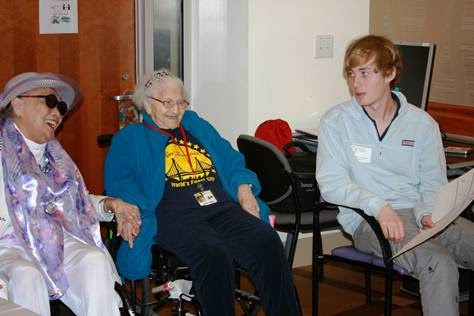
Duncan McDonell, right, with seniors from Institute on Aging
EDITOR’S NOTE: This guest post and photos appear courtesy of Duncan McDonell, a sophomore at Stuart Hall High School in San Francisco. His school of one of 22 that belong to the Sacred Heart Network of schools in the United States. 

In my first blog post here, “Art as a Tool for Intergenerational Connection,” I talked about my work with older adults at the Institute on Aging (IOA), thanks to the Youth Jumpstart Grant from Generations United and Mentor Up.

That’s how I met Jessica McCracken, my mentor and program manager of IOA’s intergenerational arts program, Center for Elders and Youth in the Arts (CEYA). At IOA, Jessica and I teach art in the day centers.

Part of my goal for the Youth Jumpstart Grant was to expand IOA’s intergenerational arts programs with help from my high school’s Students in Action (SIA) team, of which I’m a member.

This program is part of our Service Learning Program directed by Raymond O’Connor, who is a great man and has helped me with my project tremendously.

SIA youth with elder partner
In SIA, we organize community service activities, present monthly service awards to members of our community, fundraise, and promote service learning throughout our school. The whole SIA program is amazing. I’m honored to be a part of it.  

This year, the SIA team headed our school service day, the day our entire school (and affiliated junior high school) break into groups and travel around the Bay Area to provide community service.

While brainstorming where to host some of our service sites, I suggested Institute on Aging, an idea the SIA group strongly supported. They chose me to lead our project.

Before our March 14, 2014 school-wide Service Day, Jessica and I felt the need to provide sensitivity training to my peers at Stuart Hall High School before they came to teach.

We met with seven students for an hour at school and, using a presentation Jessie and I made, we discussed various strategies for how to make the seniors’ and the students’ experiences as meaningful as possible.  

Jessie talked about IOA and its 24 programs that enhance the quality of life for older adults.  She also discussed age-related changes and the particulars of working with a frail older population, and I added tips that I picked up from my experiences.

Another SIA youth with his elder partner
My main tips were never judge anyone, especially elders, by first impressions and don’t be afraid to interact with the seniors or engage them in conversation.

After our sensitivity training, which went very well, we were ready to teach. Our group was comprised of five high schoolers and two junior high kids.  Everyone that went was passionate about art and enthusiastic about interacting with elders, as they were allowed to choose their service day elective.

At IOA, we paired each youth with seven elders and worked on a drawing-interview activity, in which we filled boxes with drawings of each of their favorite things (e.g., food, animals, places).  

The students then stood at the front of the room as they presented their project and told us about themselves and their partner elder.  

It was an excellent activity in my opinion because it helped us all learn about each other and our interests.   

All the seniors loved the class and so did the students.  One of my peers even told Jessie and me that “serving the seniors really made me feel like I was making someone’s life a little better, something I aspire to do in the future”.

I’m so glad we were able to not only help the seniors have a good time, but the kids as well.  Throughout the course of this wonderful day, Jessica and I were able to expand and improve IOA’s arts program.

Not to mention, we enjoyed it as well!

Duncan McDonell
Stuart Hall High School
San Francisco, CA
Class of 2016

Tuesday, August 12, 2014

Bridge Meadows

EDITOR’s NOTE: Each week, we’ll feature intergenerational program ideas that were tried and successful. This series is a tool to highlight various age-optimized programs and practices. The program descriptions are provided by representatives of the programs. Inclusion in this series does not imply Generations United’s endorsement or recommendation, but rather encourages ideas to inspire other programs.

In part 12 of our series, we feature Bridge Meadows, a unique multigenerational community located in the Portsmouth neighborhood of North Portland.

(Read parts 1, 2, 3, 4, 5, 6, 7, 8, 9, 10 and 11.)

Bridge Meadows is where adoptive parents, foster children and elders - those over 55 - find a true home built with love and the shared vision of a better tomorrow.

At Bridge Meadows, current and former foster youth have the stability, caring connections and educational supports they need to succeed and re-calibrate the trajectory of their lives.

Investing in the safety and security of these children today improves the quality of life for everyone tomorrow.

Children move out from the instability of foster care placements to permanent homes, families and parents receive essential resources and guidance, while elders find safe, affordable housing and an opportunity to make a meaningful difference in the lives of families and their children.

Bridge Meadows is an innovative solution at the intersection of child welfare, aging and affordable housing - issues that impact each of us; not just socially and emotionally, but economically as well.

Got something cool you tried that was successful? Why not tweet your cool intergenerational ideas to #cooligideas? You can also post them to our Intergenerational Connections Facebook Group. Youth Jumpstart Grantees can share ideas here. Or just text us through the Facebook Messenger app (friend me to join our Cool Intergenerational Ideas group discussion). We want to highlight innovative age-optimized programs and practices through our blog, social media and weekly e-newsletter!  Share the inspiration.

Monday, August 04, 2014

Ring House Inc.

Deloitte employees and their families constructed a miniature golf
hole and brought it to the Home for the putting enjoyment
of resident golf enthusiasts.
EDITOR’s NOTE: Each week, we’ll feature intergenerational program ideas that were tried and successful. This series is a tool to highlight various age-optimized programs and practices. The program descriptions are provided by representatives of the programs. Inclusion in this series does not imply Generations United’s endorsement or recommendation, but rather encourages ideas to inspire other programs.

In part 11 of our series, we feature Ring House Inc., a senior living facility on the campus of Charles E. Smith Life Communities in Rockville, MD.

(Read parts one, two, three, four, five, six, seven, eight, nine and 10.)

During nine months a year, the Ring House Activity Department works with "Technology Helper" students and teachers from the C & T Youth Technology Academy, in Rockville, to give our senior population learning opportunities with technical tools.

The students and seniors have developed relationships and shared learning experiences together while creating a blog site. This intergenerational collaboration has expanded into summer sessions, musical performances, and an intergenerational garden.

Each summer session incorporates opportunities for integrating language arts, public speaking, growing plants, and outdoor exercise.

These sessions are documented with photography for an annual intergenerational exhibit open to the public.

Got something cool you tried that was successful? Why not tweet your cool intergenerational ideas to #cooligideas? You can also post them to our Intergenerational Connections Facebook Group. Youth Jumpstart Grantees can share ideas here. Or just text us through the Facebook Messenger app (friend me to join our Cool Intergenerational Ideas group discussion). We want to highlight innovative age-optimized programs and practices through our blog, social media and weekly e-newsletter!  Share the inspiration.

Multigenerational Housing in an Expensive Locale: Problems and Solutions Part I - Problems

Brandon Baunach is an architect
with 17 years of experience in designing
multi-family projects.
This post appears courtesy of Brandon Baunach, an architect with 17 years of experience

Out of pure necessity, I've stumbled into a lifestyle that is not only supportive and rewarding for my entire family, but also is incredibly affordable. This might sound impossible living in the San Francisco Bay Area, but I've discovered a new housing typology that can make this happen.

In 2007, my wife and I, living in San Francisco at the time, had our first son. Although we owned our home and had a very reasonable mortgage, we couldn't see ourselves living in a 600-square-foot one-bedroom condo for much longer. We also discovered that we both needed to work to continue supporting our family. We quickly started childcare with our son, and found that the two thousand dollars per month that we spent was absolutely debilitating. We could not sustain our San Francisco lifestyle any longer and sought alternative solutions. That’s when we came to the very strategic decision to buy a house with my mother, and she would help with the childcare.

As it turns out, we were not alone in this decision. In fact, the National Association of Realtors reported that 14% of all homes sold in 2013 were to households of two or more adult generations. This is a massive and enduring demographic shift.

As we set out to buy a home together, we made many assumptions on how we wanted to live and decided to buy either a duplex or a home with an accessory dwelling unit, or “granny flat” as it’s often referred. 

Stock Image
We initially looked to buy a home in San Francisco. After all, my wife and I had spent the past fifteen years in our Mission District neighborhood, and had no intention of leaving. My mother loved the neighborhood, as well, because it was very walkable which she loved. We also had a fairly good budget based on our collective multigenerational buying power.

Problems

Although our budget was good, when we started looking we saw reoccurring problems that went well beyond budget issues. Nearly every duplex we saw would have required us to make a heartbreaking eviction for us to be able to occupy the home. In one instance, we went to an open house where there was an older tenant with an oxygen tank waiting in a bedroom for realtors and their clients to leave.

We also saw many homes with illegal granny flats built into the ground floors. Until very recently all granny flats were illegal in San Francisco. We didn't mind buying a home with an illegal granny flat, but we definitely felt that because of San Francisco’s previous ban, the quality of construction did not give my mother much confidence if she were to be an equal partner in this home.

Our defiance to evict long term tenants from their homes or accept badly constructed accessory units left us with little choice of inventory. After two years of searching, we eventually gave up and decided to move to Berkeley, CA, where we found cute duplexes and multigenerational neighbors in greater supply.

This multigenerational home, designed by Deltec,
has a 2,000 sq ft living space with a 500 sq ft "granny flat."
Solutions

Our experience made us wonder how any family with multiple generations could survive in San Francisco or any dense urban area. This led me into studying how we live as a family and how developers, city planners, and financiers could respond with novel solutions for families of multiple generations. 

In future posts,  I’ll explore different designs developers could implement that would be attractive to multigenerational buyers, I’ll suggest planning strategies that would loosen the grip planning codes have on multigenerational housing innovation, and  I will suggest mechanisms for financing multigenerational projects from an individual buyer level and a development financing level.

Brandon Baunach is an architect at BAR Architects in San Francisco, CA. He lives in Berkeley, CA, with his wife, mother, and two sons. 

Grandparents Day Blog: "Fortunate"

Picture of Sheri with her grandparents on her wedding day,
December 26, 1999.
I was a very fortunate kid.  I grew up just a short drive away from all four of my grandparents (and even three of my great-grandparents).  My parents and my grandparents made sure I was able to spend plenty of time with them.  In retrospect, I think I also demanded to spend a lot of time with them!  When given this assignment, I had a hard time pinpointing specific memories to write about; mainly since my grandparents play such integral parts in all my memories.

I remember countless sleepovers with both sets of grandparents.  At one house, I slept between my grandparents in their bed, where my grandfather would sing songs and tell spooky stories.  At the others’ house, I remember the impromptu sleepovers where I would get to wear one of my grandmother’s nightgowns and my grandfather would cook pancakes in the morning.  Whether swimming in their pool with my aunts and cousins; snapping beans in the basement; hiding in the dog house with the dogs; sledding down the massive hill in their backyard; spending weeks at their house during the summer and then begging my parents to let me stay longer (I remember a lot of begging); working for my grandfather during high school and college; or many, many more wonderful times; my grandparents always made me feel very special and very loved.

I am also a very fortunate adult.  I still live just a short drive away from all four of my grandparents.  Although I don’t get to see them as often as I like, they remain incredible grandparents to me and incredible great-grandparents to my two children.   Things really haven’t changed, they are still helping me to create wonderful memories, and they still make me feel very special and very loved.

Written by: Sheri Steinig

Grandparents Day Blog: Grandma Fannie

My grandmother was married 3 times and she outlived all three of her husbands.  Her last husband, known as “Mr. Jim” and referred to as “Big Daddy,” reminded me of a kind-hearted old workhorse.   He chewed tobacco and would not let us play cards in the house, nor could we listen to the radio on Sunday.  Being the resilient children that we were, we found other places to play where we would not get caught with the cards.

During the visits to North Carolina we had a wonderful time playing on my grandmother’s farm.  Granny had nine children and also raised two of my mother’s nephews (with nine children already, what were two more?).  There were always plenty of other children to play with, and hide-and-seek was a favorite, as there were so many good places to hide on a farm.  It was great sport to harass the chickens, feed the pigs and hide near the outhouse.  It was a great improvement when a bathroom was installed on the enclosed back porch but it was still a chilly venture.  Granny was very frugal and children were the recipients of the thinnest slice of her rich, buttery pound cakes.  And you dare not make your dishpan water too sudsy as this was an indication that you had used entirely too much soap!

In her later years, she developed a skin condition known as vitiligo and in my naïve youth I thought it came from drinking water from the well.  I remember when my mother brought her up North to live with us a short while, the doctors wanted to give her a pacemaker but she was having none of that.  And she was right. In a short period of time, whatever was wrong with her heart corrected itself without the pacemaker.  Another time I was upstairs in my bedroom reading a book and finally realized that someone was calling my name, “Tina,” “Tina” I heard faintly.  When I ran downstairs, I found my grandmother lying on the floor beside the bed.  She had just missed falling into a glass storm door pane left leaning against the wall.  Even though I was visibly shaken, I made light of it by putting my hands on my hips, cocking my head to the side and saying, “Granny, now what are you doing down there on the floor?”  She laughed when I said that, and as I helped her get up and back into bed, I thought that bones must get heavier with age because it was extremely hard to lift her.

My fondest memory is combing her thin silver hair as she sat in a chair in the dining room.  As I was combing her hair, I told her that she looked like an old Native American and that made her laugh gently and smile.  Before she passed at the age of 94, she said she was “tired, just tired.”  To this day when I tease my 86-year-old Mom by calling her “Miss Fannie” we laugh together in memory and understanding as we both know that name means the spirit of Grandma is nearby.

Written by Bettina Thorpe-Tucker

Grandparents Day Blog: The Joy of Baking

Leah (right) with her husband, daughters and Oma
I remember going to visit my grandparents in Utica, NY (a couple times a year) and knowing that there would be lots of homemade baked from scratch goodies waiting for my family’s arrival.

My grandmother would bake my dad’s (her son’s) childhood favorites along with those of my mom, my brother and myself.

During our stay, we would bake more to make sure we had a different dessert every night after dinner, and plenty of homemade treats during the day.

I knew, as a child, that baking was something my grandmother not only enjoyed, but also a way that she expressed her love for others.

As I got older, I began to bake, and realized not only do I enjoy the actual art of baking, but also making others happy by baking their favorite treats, just like my grandmother.  I, learned from the best, and only bake from scratch, just like my grandmother.

Every Thanksgiving, I make pumpkin cheesecake, a favorite of many of my guests, especially my grandmother.

Oma's birthday
My grandmother and I are passing on the love and enjoyment of baking to my daughters.  Now, every time I bake, I have 2 or 4 extra little hands measuring, pouring, mixing and tasting.

I don’t know which part is more fun – laughing with them as they make a mess, accomplishing our goal or enjoying the final product!

I often have conversations with my grandmother about baking, recipes and sweets in general. There is nothing like food to elicit conversation and connections.

Happy Grandparent’s Day, Oma……….I’ll be over with some black forest cake later!

Written By: Leah Bradley

Grandparents Day Blog: "I Love You"

I don’t have the stories of long nights listening to my grandpa tell stories like many kids.  My grandfather was born deaf.

Until I was in high school, he lived in a retirement community in Florida, and I would usually see him once a year during a family visit. Although American Sign Language was my father’s first language, he and my mother are both hearing and sign language wasn’t spoken in my home regularly. I learned to finger spell the alphabet, and a few basic signs, but my communication with grandpa as a child was mostly limited to pantomime, facial expressions, and written notes.  My grandmother was also deaf. She lost her hearing as an infant. She would often vocalize some of her words in soft strained tones, but grandpa never made an intentional vocal noise.

Grandpa moved in with my family in high school after my grandmother died. Occupied with schoolwork, clubs, band, sports and friends, I never learned much more sign. However, I did have many warm and sometimes transforming moments with grandpa doing puzzles, watching Wheel of Fortune together, and hearing stories about his childhood thru my dad, the interpreter.  Grandpa, who died at 98,  remains today to be one of the most direct, humble, gentle and patient men I have ever known.

The year I left for college, grandpa turned 90. Midway thru my first semester, Grandpa and Dad decided to make the 14 hour trip from Illinois to Pennsylvania to come visit. They called me at my dorm from their hotel when they arrived.  Dad launched into how the trip went and was starting into making plans to meet up for dinner, when grandpa interrupted and asked for the phone.  The next thing I heard was the gentle but dragging murmur of what sounded like a tape recorded voice playing on the wrong speed, “III  LLLOVVE  YYOUU”. My dad got back on the phone, choked up. “I have never heard my father speak,” he said.

I may not have gotten to spend hours listening to my grandpa tell stories like many kids, but the words I did hear from him, I will never forget.

Written By: Jaia Peterson-Lent

Tuesday, July 29, 2014

Geriatric Career Development Program at Jewish Home Lifecare - 2014 Program of Distinction Designee

PHOTO: Jewish Home Lifecare
In part 3 of our series on the 2014 Program of Distinction Designees, we highlight Geriatric Career Development Program at Jewish Home Lifecare, a LeadingAge member based in New York City.  (Read parts one and two.)

In addition to helping at-risk New York City high school students climb career ladders in health care, Geriatric Career Development (GCD) program enjoys the bragging rights and national legitimacy that comes from joining an elite group of programs celebrated for their effectiveness.


Since 2006, GCD served as a pipeline to develop the next generation of diverse, culturally competent leaders in long-term care.

The program serves 200 at-risk high school students (10th-12th grade) annually through a comprehensive three-year curriculum that encompasses rigorous academic tutoring and college preparation; extensive workforce training and healthcare certification; professional mentorship; intergenerational learning; family involvement; and life-skills counseling.  

PHOTO: Jewish Home Lifecare
The students spend three years working directly with the elders at Jewish Home Lifecare in a variety of capacities.

Students host social group events for the elders, select an elder mentor for specialized one-on-one activities and assist the nursing staff in a clinical role focusing on person directed care.

Students leave the program college-bound and with a certification in one or more allied health occupations (Medical Billing and Coding, Certified Nursing Assistant, Patient Care Technician, CPR, Electrocardiography Technician, and Phlebotomy Technician).

The Program continues to mentor and track its growing alumni chapter (now 313 young adults) by providing support services related to college persistence, employment opportunities and life skills.

A program object is that GCD graduates attend college or gain employment in the health care system. Mohammed Abdullah, a recent grad, did both. He’s currently a certified nursing assistant at Jewish Home Lifecare’s Bronx campus and attends Jersey Collage School of Nursing.

“I didn’t think a program like GCD would benefit me,” said Abdullah, who remembered his high school days when he walked the halls with his friends, showed up to class late and talked back to his teachers.

“But then when I started,” he concluded, “I became more responsible.”

Kendal at Oberlin

EDITOR’s NOTE: Each week, we’ll feature intergenerational program ideas that were tried and successful. This series is a tool to highlight various age-optimized programs and practices. The program descriptions are provided by representatives of the programs. Inclusion in this series does not imply Generations United’s endorsement or recommendation, but rather encourages ideas to inspire other programs.

In part 10 of our series, we feature Kendal at Oberlin, an Ohio-based nonprofit and retirement community that promote civic involvement with the wider community and social relationships.


(Read parts onetwothreefourfivesixseven, eight and nine.)

Through their residents’ work with Kendal Early LearningCenter, Kendal at Oberlin’s multifaceted intergenerational program reaches the larger community of Oberlin and Lorain County featuring an onsite Early Learning Center.

Kendal residents and staff play a significant role in mentoring students from more than nine educational institutions. Our community believes in the commitment to mentor the next generation.

Examples of Intergenerational Experiences include:

·    the one-to-one support of a resident volunteer during the morning preschool curriculum (i.e. a special story in quiet area, or help to create a John Deere tractor from a cardboard box, an extra pair of hands on a walk to the Russia Township Park or learning about the life of the honey bee from a special visit from an on-site resident beekeeper.)

·    A trip on the Kendal bus to the public library, or a field trip to a local apple orchard or one of the Lorain County metro parks with resident volunteers supporting hands-on learning.

·    Joining our Stephen's Care friends to make Green Eggs and Ham and celebrate Dr.Suess' birthday or enjoying an art or music experiences planned through the creative arts department.

The Early Learning Center opened at the same time as the Kendal at Oberlin retirement community and focuses on children 18 months – 5 years old. The Center creates opportunities for residents to continue their passion for teaching young children, as well as being with surrogate grandchildren.

Got something cool you tried that was successful? Why not tweet your cool intergenerational ideas to #cooligideas? You can also post them to our Intergenerational Connections Facebook Group. Youth Jumpstart Grantees can share ideas here. Or just text us through the Facebook Messenger app (friend me to join our Cool Intergenerational Ideas group discussion). We want to highlight innovative age-optimized programs and practices through our blog, social media and weekly e-newsletter!  Share the inspiration.


Monday, July 28, 2014

Grandparents Day Blog: Jack and Marion Hlava

Adam Hlava's grandparents
Jack and Marion Hlava were married on June 18th 1949 in the central Wisconsin town of Mosinee. They had five children, and among them was my father. After leaving Mosinee, Grandma and Grandpa Hlava spent the rest of their lives in the small paper town of Green Bay, and their house sat on Ridge Road just a few short blocks away from the famed Lambeau Field, home of the Green Bay Packers.

When I was very young I remember the car rides to their house marked by the left turn just in front of the colossal football shrine. Often I was forced against my will to wear an itchy sweater in my best effort to be as photogenic as possible for the family photo. But I toughed through it, because going to grandma and grandpa’s house meant great food, hanging out with the family, but most importantly there was usually a Packer game involved.

Speaking of the Green Bay Packers, for anyone from the great state of Wisconsin (Green Bay in particular) watching the games were as commonplace as breathing. Being a fan is simply a part of everyday life there, and there were no bigger Packer fans that I knew of than my grandparents. If anything I remember of them, it was the look of sheer jubilation at every great win, and the heart retching agony of every loss. But we shared in it together as a family and it was a special bond that I’ll never forget. In 1996 the Packers went on to win the Super Bowl for the first time in my life, and I was there at Grandma and Grandpa’s house cheering them on with my family.

This year when I celebrate Grandparents Day, I’ll be thinking about those car rides past Lambeau Field to my grandparents’ house. I’ll remember those awful striped sweaters I used to wear during the holidays at their house, and the hearty meals we ate when the temperatures dipped below zero. I’ll remember the jubilation of every Packer victory and the agony of every loss when we all watched the games together. I’m proud to say that the time spent with my grandparents made me who I am today; I cherish the time with my family, am a lifelong Packer fan which I will be passed down to the next generation, and I still hate itchy sweaters.

Written By: Adam Hlava

Tuesday, July 22, 2014

Family Care Center at Virginia Commonwealth University Health Systems - 2014 Program of Distinction Designee

In part 2 of our series on the 2014 Program of Distinction Designee, we highlight Family Care Center at Virginia Commonwealth University Health Systems in Richmond, VA. (Read part one.)

The Family Care Center – among this year’s honorees, including AARP Experience Corps and Geriatric Career Development Program at Jewish Home Lifecare – enjoy the bragging rights and national legitimacy that comes from joining an elite group of programs celebrated for their effectiveness.

(See our post, “What is a Program of Distinction Designeeand why is it so important?”)

"When it opened more than 30 years ago, ours was one of the very first employer sponsored on-site child care centers in Virginia. When we added our adult day services program in 2006, it was the first of its kind," explains Maria Curran, vice president, Department of Human Resources and Family Care. 

"We have long known about the many significant advantages of integrating the care of seniors and children and are thrilled to be recognized by Generations United as a Program of Distinction," Curran continued. "Our program is one of the flagship benefits we offer our employees but it also is open to our community, which extends the benefit even further."

Family Care Center, like our past designees, went through a tough consideration process facilitated by our panel of experts in the intergenerational field.

The VCU Health System Family Care Center is a shared intergenerational site located on the Medical Campus of Virginia Commonwealth University.  

“We are very excited about receiving 'The Program of Distinction Award' offered by Generations United," said Patricia Moon, director, VCU Health System Family Care Services.. "It is both an honor and a privilege to receive this recognition of our efforts to ensure best practices in the field of intergenerational programming and elder care when there are so many programs deserving of this distinction."  
"Our elders and our children have been the recipients of the improved quality of life initiatives that have come from their experiences," Moon concluded.  

The diversity of ages and opportunities within this center is a result of its NAEYC-accredited childcare center serving children ages 6 weeks to 12 years and an Adult Day Center licensed for 10 adults with varying abilities who need or desire opportunities for engagement, supervision and socialization. 

The opportunities for intergenerational interactions are significant and further expanded since the Family Care Center is part of a teaching hospital and supports students and interns from a variety of disciplines.

"I am thrilled to receive this honor from Generations United, and very proud of the exceptional care environment we have created at this shared site," observed Dee Caras, MSG, program manager, VCU Health Systems Adult Day Services. "This designation will help us continue and will strengthen our good work through increased recognition and awareness of our program."

Stay tuned for next week, when we introduce Jewish Home Lifecare’s Geriatric Career Development Program. 

Tuesday, July 15, 2014

The Robert J. Dole Institute of Politics

EDITOR'S NOTE: Each week, we'll feature intergenerational program ideas that were tried and successful. This new series is a tool to highlight various age-optimized programs and practices. The program descriptions are provided by representatives of the programs. Inclusion in this series does not imply Generations United's endorsement or recommendation, but rather encourages ideas to inspire other programs.

In part nine of our series, we feature the Robert J. Dole Institute of Politics, a nonpartisan political institution housed at the University of Kansas. (Read parts onetwothreefourfivesixseven and eight.)

Launched in July 22, 2003, the Robert J. Dole Institute of Politics recently started an intergenerational mentoring program with members of the Friends of the Dole Institute and the Dole Institute’s Student Advisory Board.

The Friends of the Dole Institute is an annual giving program made up mostly of retirees in the Lawrence, Kansas community. Members of the Student Advisory Board are undergraduate and graduate students at the University of Kansas interested in public service and civic engagement.

The Dole Institute Mentoring Program was developed with three goals in mind:1.    
  1. To foster deeper connections between the Friends of the Dole Institute and our Student Advisory Board,  
  2. To provide a forum for individuals of all ages to practice civil discourse by facilitating meaningful discussions on topics related to Dole Institute programs, and
  3. To develop students’ skills, values, and a sense of empowerment, leadership, and citizenship.
Mentors and mentees were matched based on their interests and met at three facilitated meetings throughout the semester, as well as on their own.

The activity among mentors and mentees took off quickly after our first facilitated meeting. Mentors and mentees did everything together from attending Dole Institute programs, to touring art museums, and even attending sporting events!

Got something cool you tried that was successful? Why not tweet your cool intergenerational ideas to  #cooligideas? You can also post them to our  IntergenerationalConnections Facebook Group. Youth Jumpstart Grantees can share ideas here. Or just text us through the Facebook Messenger app (friend me to join our Cool Intergenerational Ideas group discussion). We want to highlight innovative age-optimized programs and practices through our blog, social media and weekly e-newsletter!  Share the inspiration.

AARP Experience Corps - 2014 Program of Distinction Designee

Lequetta Diggs, an AARP Experience Corps volunteer, working
with students at Maxfield Elementry school in St. Paul
to help develop their reading skills.
Photos courtesy of AARP Experience Corps.

In the four years Generations United, through our partnership with New York Life Foundation, presented the Programs of Distinction Award, we realized something: our applicants are adventurers at heart, whether they know it or not.  

While applying isn’t as dangerous as wingsuit gliding off a 13,000-foot mountain or kayaking over a waterfall, the consideration process is just as rigorous.

That’s why our successful applicants enjoy the bragging rights and national legitimacy that comes from joining an elite group of programs celebrated for their effectiveness. (See our post, “What is a Program of Distinction Designee and why is it so important?”)

This year’s honorees are AARP Experience Corps, Family Care Center at Virginia Commonwealth University and Geriatric Career Development Program at Jewish Home Lifecare.

This post is one of a three-part series, highlighting our 2014 designees. First up, is AARP Experience Corps.

What makes this an award-winning national program is how it engages people 50-plus years old to meet their community's greatest challenges.

Two thousand AARP Experience Corps volunteer members tutor and mentor in 19 cities across the country, providing literacy coaching, homework help, consistent role models and committed, caring attention.

Independent research shows that AARP Experience Corps boosts student academic performance, helps schools and youth-serving organizations become more successful, and enhances the well-being of adults 50 and older in the process.

They tap into the desire for 50-plus adults to be engaged in community, leveraging their capacity to create lasting change and making sure we conduct the research necessary to deliver the best results.


Their volunteer members tutor children who need basic literacy skills, they mentor students who count on them for guidance, they partner with classroom teachers to make schools better places to learn and they help create healthier communities. Learn more about AARP Experience Corp.

Stay tuned for next week, when we introduce Family Care Center at Virginia Commonwealth University Health Systems.  

Friday, July 11, 2014

Generations United Statement on the Preventing Sex Trafficking and Strengthening Families Act

Generations United applauds the bicameral, bipartisan agreement on the Preventing Sex Traffickingand Strengthening Families Act (H.R. 4980) for recognizing and supporting the needs of grandfamilies, families where children are being raised by grandparents or other relatives either inside or outside of the formal foster care system.

Specifically, children being raised in grandfamilies will benefit from the provisions which: 
  • extend kinship navigators and family finding through Family Connection Grants,
  • expand the adoption incentives program to include permanent guardianships and increase incentives for older youth,
  • promote “normalcy” for children in foster care including kinship foster care,
  • more fully engage youth in planning for their permanency,
  • require adoption assistance de-link savings to be reinvested in post-permanency services, and
  • preserve eligibility for kinship guardianship assistance payments with a successor guardian.
While we affirm these important steps to supporting grandfamilies, we elevate the need for further reforms and ladders to stability and permanency for children.   In particular we are committed to working with both parties to ensure the Family Connection Grants are extended beyond the current year. These grants support kinship navigator programs, one of the few sources of information and support for grandfamilies who are both keeping children with extended family and saving taxpayers more than $6.5 billion each year by keeping children out of foster care.

Generations United looks forward to supporting future efforts related to child welfare finance reform and ensuring the availability of additional prevention, post-permanency services and other supports for grandfamilies who step up to raise children when they cannot remain with their birth parents.

Thank you for your commitment to ensuring safe, stable and permanent homes for children and preserving their family and cultural ties whenever possible.