EDITOR’S NOTE: Each week, we feature intergenerational program ideas that were tried and successful. This series is a tool to highlight various age-optimized programs and practices. The program descriptions are provided by representatives of the programs. Inclusion in this series does not imply Generations United’s endorsement or recommendation, but rather encourages ideas to inspire other programs.
This week’s cool idea is the Cross Cultural Community Center in Chicago, where college students teach cooking classes for older adults.
(Check our archives for parts 1-42.)
The classes focus on youth educating older adults about American foods – tips on cooking, nutrition and health.
The goal is to help the older adults become more independent by learning how to cook their own healthy meals, while strengthening intergenerational connections and understanding.
Some of their other programs include youth and older adults gardening together, helping Korean-American older adults translate English, and providing grandparents raising grandkids with information and resources.
Got something cool you tried that was successful? Why not tweet your cool intergenerational ideas to #cooligideas? You can also post them to our Intergenerational Connections Facebook Group. We want to highlight innovative age-optimized programs and practices through our blog, social media and weekly e-newsletter! Share the inspiration.

Tuesday, April 28, 2015


Tuesday, April 21, 2015
Students Inter-generational Art to Protect Nature

This week’s cool idea is the “Students Inter-generational Art to Protect Nature,” the result of more than 60 pieces of art from Sauk Trail fourth-grade students and older adults in Middleton, Wisconsin, who are concerned about the importance of preserving local nature.
(Check our archives for parts 1-41.)
The program began by observing and discussing nature, wildlife, and habitats seen at Pheasant Branch Conservancy.
The students then spent an afternoon interviewing senior citizens at Middleton Glen Retirement Community, Heritage Senior Living, and Middleton Senior Center to hear what the environment was like when the seniors were fourth-graders.
Back in the classroom, students discussed what they learned, along with what has changed in nature, the environment, and in life.
They agreed there is a strong need to protect natural resources for future generations.
Students in each of the three fourth-grade classrooms created a booklet, drawing a scene from nature for each letter of the alphabet and writing about it.
Got something cool you tried that was successful? Why not tweet your cool intergenerational ideas to #cooligideas? You can also post them to our Intergenerational Connections Facebook Group. We want to highlight innovative age-optimized programs and practices through our blog, social media and weekly e-newsletter! Share the inspiration.
Monday, April 13, 2015
Arizona Education Association - Retired's IMPACT Intergenerational Mentoring Program
 |
| (PHOTO: John Miller) Elizabeth Gonzales (right) say mentor Juan Zúñiga guided her, but still let her find her own way. |
This week’s cool idea is the Arizona Education Association- Retired’s IMPACT Intergenerational Mentoring Program, an intergenerational partnership that allows retired educators to mentor young teachers.
(Check our archives for parts 1-40.)
The intergenerational mentoring program is a collaborative project between the Arizona Education Association-Retired (AEA-Retired), and AEA-Student Program (AEA-SP) with the full support and cooperation of the National Education Association, the Arizona Education Association, Arizona State University, and the University of Arizona.
Their mission is to establish and maintain an ongoing mentorship program between the AEA-Retired and the AEA-SP that will continue through the student-teaching experience and first five years of teaching.
As a result, the program has utilized the knowledge and experience of retired teachers in the development and training of future teachers by providing no-cost professional development sessions.
Beginning teachers are also able to share real challenges they face and their mentors help address those challenges.
Got something cool you tried that was successful? Why not tweet your cool intergenerational ideas to #cooligideas? You can also post them to our Intergenerational Connections Facebook Group. We want to highlight innovative age-optimized programs and practices through our blog, social media and weekly e-newsletter! Share the inspiration.
Monday, April 06, 2015
Senior Design Factory
 |
| (PHOTO: Senior Factory Design) Benjamin Moser (2nd from left) and Debora Biffi (2nd from right) founded the Senior Design Factory to bring old and young people together. |
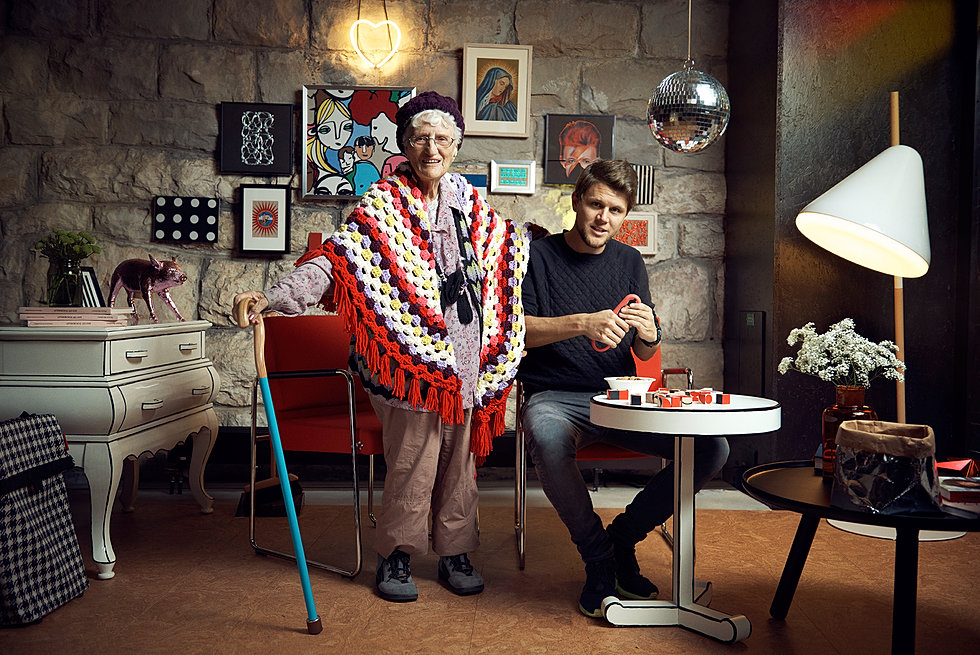
This week’s cool idea is the Senior Design Factory, based in Zurich, Switzerland. The company’s centerpiece is the ‘Atelier’, or studio, where young designers work together with older adults who have craft skills.
(Check our archives for parts 1-39.)
The Senior Design Factory, founded by Debora Biffi and Benjamin Moser, pursues the objective of bringing together old and young persons as partners of equal value, and encouraging communication between the generations through engagement in creative projects.
 |
| (PHOTO: Senior Factory Design) Click the image to enlarge. |
It highlights new ways in which older people can be linked in with everyday living, and their resources and talents used intelligently.
(Read the March 23 New York Times article on the Senior Design Factory.)
Design plays a central part in this project, functioning as a mediator and building bridges between the generations on the social and creative planes.
The centerpiece is the 'Atelier' or studio, where young designers work together with senior citizens who have craft skills.
The 'Shop' then markets the products they have created.
The 'Kitchen' restaurant is designed to be a cross-generational meeting place, and the 'Workshops' serve for the exchange and transfer of knowledge between young and old.
 |
| (PHOTO: Senior Factory Design) |
Debora Biffi and Benjamin Moser studied Style & Design at the Zurich University of the Arts.
In 2008, they developed the Senior Design project as a diploma study, working with retired people and the young and linking up the ideas and abilities of the generations.
The project met with an enthusiastic response, and continues to do so. Senior Design is now established as a charitable organisation.
Got something cool you tried that was successful? Why not tweet your cool intergenerational ideas to #cooligideas? You can also post them to our Intergenerational Connections Facebook Group. We want to highlight innovative age-optimized programs and practices through our blog, social media and weekly e-newsletter! Share the inspiration.
Tuesday, March 31, 2015
Pinebelt Association for Families

This week’s cool idea is the Pinebelt Association for Families, a kinship care program that works with 75 families in southern Mississippi’s four counties.
(Check our archives for parts 1-38.)
For the past fifteen years, The Pinebelt Association for Families (PAFF) has worked with families across the lifespan.
 Since its inception in 1999, PAFF has supported kinship families (grandparents and other relatives raising grandchildren) and now works with some 75 families in four counties in southern Mississippi (Covington, Forrest, Jones, and Smith).
Services have been supported by monies from The National Family Caregiver Support Program administered through Area Agency on Aging of the Southern Mississippi Planning and Development District, United Way of Southeast Mississippi and private foundations.
PAFF also serves largely homebound senior adults through our S.O.S. Program (Serving Our Seniors) providing home visiting, commodities, safety kits and available fresh fruits and vegetables.
Got something cool you tried that was successful? Why not tweet your cool intergenerational ideas to #cooligideas? You can also post them to our Intergenerational Connections Facebook Group. We want to highlight innovative age-optimized programs and practices through our blog, social media and weekly e-newsletter! Share the inspiration.
Monday, March 23, 2015
RSVP BABES (Beginning Alcohol and Addictions Basic Education Studies)

This week’s cool idea is RSVP BABES, a Beloit, WI-based program that uses colorful puppets to encourage children to live happy, healthy lives free from abuse.
(Check our archives for parts 1-37.)
Trained RSVP volunteers using BABES (Beginning Alcohol and Addictions Basic Education Studies) puppets and a script present accurate, nonjudgmental and age-appropriate information to all second grade classes in Portage County.
 The program is designed to help children by promoting self-esteem, defining peer pressure and practicing good decision-making skills.
The program also helps the children understand and develop skills necessary to cope with unhappy situations and stresses the importance of asking for help.
Got something cool you tried that was successful? Why not tweet your cool intergenerational ideas to #cooligideas? You can also post them to our Intergenerational Connections Facebook Group. We want to highlight innovative age-optimized programs and practices through our blog, social media and weekly e-newsletter! Share the inspiration.
Friday, March 20, 2015
Between the Lines - World Poetry Day
 |
| "Between the Lines" members |
The program was started by Patti Russo, a certified poetry therapist from Carlisle, MA, a MetLife Foundation/Generations United 2015 Best Intergenerational Communities award winner.
“Generations United opened my eyes to the field of intergenerational work and the many ways I can use poetry to bring generations together," said Russo, whose program works with Easter Seals, Pre-K and High Schools.
She continued:
In 2006, I was hired by Easter Seals to work on a grant they received from Generations United to explore how expressive therapies might bridge the intergenerational gap.
I had previously used poetry with the bookend generations individually, but it had never occurred to me to work with them at the same time.
About ten minutes into the first session I realized the power of this intergenerational work and instantly wanted to do more of it.
 |
| Patti (right) created a "Poetry Booth" at Old Home Day 2012 in Carlisle, MA to promote poetry in the community. |
In addition to the benefits of poetry both generations experienced, the older adults profited from the kids' enthusiasm and energy and the children basked in the one-on-one attention they received from the adults.
After that initial intergenerational experience funded by Generations United, I started offering intergenerational poetry groups at local preschools and high schools in the Carlisle area.
It continues to be my most meaningful work as a poetry therapist.The exquisite corpse poem, "Six-word Memoirs," that high school students did with older adults.
(See poems from Between the Lines preschool and older adult members.)
Six-word Memoirs
by
CCHS Intergenerational Poetry Group
Bold = written by high school sophomore
Sharing life experience
Living as one. (Tom D.)
Poetry, seniors, sophomores
So much fun (Lillian D.)
Old, Young
We’re all having fun. (Hung V.)
You are young then grow older (Katie A.)
2 sophomores, I senior; It all works! (Dee S.)
Seniors, Sophomore synchrony
so, so satisfying. (Gwen C.)
It’s through poetry
I find you. (Tom D.)
It’s better than normal English class. (Ben C.)
Punishment or play?
Escape with ancients! (Joan P.)
Groups aren’t so bad after all. (Joyce B.)
Time Never Stops
Until Clocks Break (Julien D.)
“100 Years,” No
“Turning Ten,” Yes (Gwen C.)
“I’m hungry. Anyone have a snack?” (Trevor H.)
Just begun—Now done—Never forgotten (Helen Y.)
I like to play sports daily! (Davante B.)
Stars, planets, galaxies
The whole universe. (Allison R.)
Getting to know, then let go. (Marje S.)
Time is wasting, make days count. (Marje S.)
Big game today; hope we win! (Allie C.)
Started off and now wanting more (Gabe A.)
I’m done practicing. Start the game. (Irwin G.)
I was glad to see Charlotte. (Bea S.)
Six word memoirs are very funny. (Charlotte C.)
Exchange of thoughts
A new awareness (Joan S.)
The twinkling star, then shining moon. (Juilia V.)
Wednesday, March 18, 2015
Dr. Joan Lombardi - Honorary Co-Chair of Seniors4Kids

She was the founding chair of what’s now called the Alliance for Early Success (formerly the Birth to Five Policy Alliance) – a collaboration of state, national and funding partners that put vulnerable young children on a path to success.
The Alliance was established by the Buffett Early Childhood Fund, where Lombardi served as advisor, offering support to states and other countries on early childhood.
She also authored a book, Time to Care: Redesigning Child Care to Promote Education, Support Families, and Build Communities, in which she sites Generations United as the only national organization advocating for the mutual well-being of children, youth and older adults.
Through a partnership with the World Forum Foundation, she launched the Global Leaders for Young Children program in 2004.
The program has since provided leadership support to 19 early education leaders from eight countries.

“There is a growing chorus,” Lombardi told EdCentral during an author spotlight, “calling for a pathway of services from the prenatal period through the early primary grades to prevent the achievement gap and get children off to a strong start.”
In spite of these efforts, Lombardi points out the haunting inequality among the nation’s youngest children and the overwhelming stress that families face every day without quality early education options.
As national honorary co-chair of Generations United’s Seniors4Kids, Lombardi and her co-chair, Mary Catherine Bateson, charge older adults to support investments in quality early childhood.
“We call on our community elders to be change makers -- advocating for better schools, improved childcare, and parenting supports at the federal, state and local levels,” Lombardi and Bateson wrote in their post, “Let's Raise Our Grand Voices in Support of Children and Families.”
For Lombardi, supports at the federal, state and local levels include new public financing strategies that bring affordable quality early childhood services to families and attract the best teachers for the youngest children.
You can stay connected with action alerts relevant to national legislation and join a large group of like-minded older adults who care about, and want to support, younger generations. Learn more
Dr. Mary Catherine Bateson - Honorary Co-Chair of Seniors4Kids

Through her book Composing a Further Life: The Age of Active Wisdom (Knopf, 2010), Bateson celebrated the contributions and improvisations of engaged older adults.
“As people grow older, some of the ways they have contributed in the past may no longer be possible,” she wrote in Composing a Further Life, “but the challenge to society is not only to provide help and care where these are needed but also to offer the opportunity to contribute and care for others.”
Bateson offered an opportunity in 2004, when she founded GrannyVoter, a non-partisan effort that helps grandparents share their voices, pool their power, and use their vote to advocate for their grandchildren.
Today, that program is now merged with Generations United’s Seniors4Kids, of which Bateson is national honorary co-chair.
Her book, Composing a Further Life, continues to lead to further exploration of intergenerational communication and changing ways of experiencing time.
Through her Huffington Post blogs, which she often co-authors with her honorary co-chair, Joan Lombardi, Bateson uses election season, Grandparents Day and various campaigns to charge older adults to support investments in generations to come.
 “Today, entering kindergarten without quality early education is like starting a race an hour behind everyone else, making it very difficult to catch up,” Bateson and Lombardi wrote in their post, “Uniting Across the Generations to Assure a Strong Start for Children.”
Those long-lasting benefits include children becoming students who are 29 percent more likely to graduate from high school, according to The First Five Years Fund.
Young people with quality early education become adults more likely to be employed and earn a 33 percent higher average salary.
As a grandparent, Bateson sees it as a responsibility for her and other older adults to protect the future of children too young to vote.
“The past empowers the present,” according to the anthropologist, “and the sweeping footsteps leading to this present mark the pathways to the future.”
You can stay connected with action alerts relevant to national legislation and join a large group of like-minded older adults who care about, and want to support, younger generations. Learn more
Monday, March 16, 2015
Foster Kinship

This week’s cool idea is Foster Kinship, a nonprofit that empowers kinship caregivers to provide the most stable and permanent placements for children in their home.
When children can’t be with their parents, they should be with their family.
 Foster Kinship is a local nonprofit exclusively focused on serving kinship families and the over 19,000 children in kinship care in Nevada.
To improve outcomes for children in kinship care, Foster Kinship empowers kinship caregivers to provide the safest, most stable and permanent placements for the children in their home.
Foster Kinship provides three free programs for kinship caregivers: support, advocacy and case management.
By helping to “keep home in the family” for these vulnerable children, Foster Kinship envisions a safe and healthy childhood for all children in kinship care.
Got something cool you tried that was successful? Why not tweet your cool intergenerational ideas to #cooligideas? You can also post them to our Intergenerational Connections Facebook Group. We want to highlight innovative age-optimized programs and practices through our blog, social media and weekly e-newsletter! Share the inspiration.
Monday, March 09, 2015
The Kahuna Kapuna
EDITOR’S NOTE: Each week, we feature intergenerational program ideas that were tried and successful. This series is a tool to highlight various age-optimized programs and practices. The program descriptions are provided by representatives of the programs. Inclusion in this series does not imply Generations United’s endorsement or recommendation, but rather encourages ideas to inspire other programs.
 This week’s cool idea is The Kahuna Kupuna, an annual shortboard and longboard surf contest in Pacifica California that honors the more experienced (in age) surfers.
(Check our archives for parts 1-35.)
While the main focus of the contest is the Kahuna Kupuna division for men and women 40 years of age and over, with separate sub-divisions for shortboard and longboard surfers, there is also an Intergenerational Team Division that welcomes surfers of all ages.
Intergenerational teams are made up of six surfers representing three or more generations and must include at least one surfer under age 20.
Got something cool you tried that was successful? Why not tweet your cool intergenerational ideas to #cooligideas? You can also post them to our Intergenerational Connections Facebook Group or just text us through the Facebook Messenger app (friend me to join our Cool Intergenerational Ideas group discussion). We want to highlight innovative age-optimized programs and practices through our blog, social media and weekly e-newsletter! Share the inspiration.
Monday, March 02, 2015
The Central Oregon Council on Aging
EDITOR’S NOTE: Each week, we feature intergenerational program ideas that were tried and successful. This series is a tool to highlight various age-optimized programs and practices. The program descriptions are provided by representatives of the programs. Inclusion in this series does not imply Generations United’s endorsement or recommendation, but rather encourages ideas to inspire other programs.
 In the latest of series, we feature the Central Oregon Council on Aging (COCOA), an intergenerational tech training for older adults based in Bend, OR.
(Check our archives for parts 1-34.)
The COCOA developed and coordinates Teen Elder Computer Help (TECH), an intergenerational training class that teams teenagers with seniors to teach Facebook, digital camera download, cell phone and Skype.
This program helps seniors stay in contact with friends and family during a time when communication is transitioning to social networking.
Through this simple goal of connecting seniors to the social network, an exceptional intergenerational experience has developed for participating teenagers and seniors.
Several seniors shared World War II stories and pictures with the teens, and teen teachers shared Facebook, Tumblr and Twitter knowledge with their senior students.
This program has minimal administrative costs associated with coordinating volunteers and hosting a volunteer recognition event at the end of each session.
Computer time and facilities are donated through senior centers, libraries, schools or laptop classes at the COCOA office.
TECH’s goal is to reach 100 seniors each year at five sites and give 30 high school students an opportunity to experience teaching.
Got something cool you tried that was successful? Why not tweet your cool intergenerational ideas to #cooligideas? You can also post them to our Intergenerational Connections Facebook Group or just text us through the Facebook Messenger app (friend me to join our Cool Intergenerational Ideas group discussion). We want to highlight innovative age-optimized programs and practices through our blog, social media and weekly e-newsletter! Share the inspiration.
Monday, February 23, 2015
Workforce Academy for Youths

In the latest of series, we feature Workforce Academy for Youth (WAY), based in San Diego County, California.
(Check our archives for parts 1-33.)
Workforce Academy for Youth (WAY) mission is to give foster youth the opportunity to learn and gain work experience to better prepare for a county position (or equivalent job) and/or to encourage him or her to continue his or her education.
The County of San Diego implemented WAY in September 2006 to provide workforce experience to those who are "aging out" of the foster care system and transitioning to self-sufficiency.
WAY is a six-month paid internship program that provides employment, training and mentorship to emancipating foster youth age 17-21.
The program unites youth with older adult Life Skill Coaches to support the development of work and life skills.
Got something cool you tried that was successful? Why not tweet your cool intergenerational ideas to #cooligideas? You can also post them to our Intergenerational Connections Facebook Group or just text us through the Facebook Messenger app (friend me to join our Cool Intergenerational Ideas group discussion). We want to highlight innovative age-optimized programs and practices through our blog, social media and weekly e-newsletter! Share the inspiration.
Wednesday, February 18, 2015
New Life Village

In the latest of series, we feature New Life Village, based in Tampa FL.
(Check our archives for parts 1-32.)
New Life Village is a unique inter-generational community conceived to encourage more people to adopt children who have been languishing in the foster care system.
New Life Village offers a place to live and a community that the children can, at last, call “Home”.
It offers eligible families a home and a supportive community with activities, programs, and services; it also offers eligible older adult resident volunteers a home to provide basic support for the families and to engage in activities within the village.
Got something cool you tried that was successful? Why not tweet your cool intergenerational ideas to #cooligideas? You can also post them to our Intergenerational Connections Facebook Group or just text us through the Facebook Messenger app (friend me to join our Cool Intergenerational Ideas group discussion). We want to highlight innovative age-optimized programs and practices through our blog, social media and weekly e-newsletter! Share the inspiration.
Thursday, February 12, 2015
Congrats to our 2015 Best Intergenerational Communities!
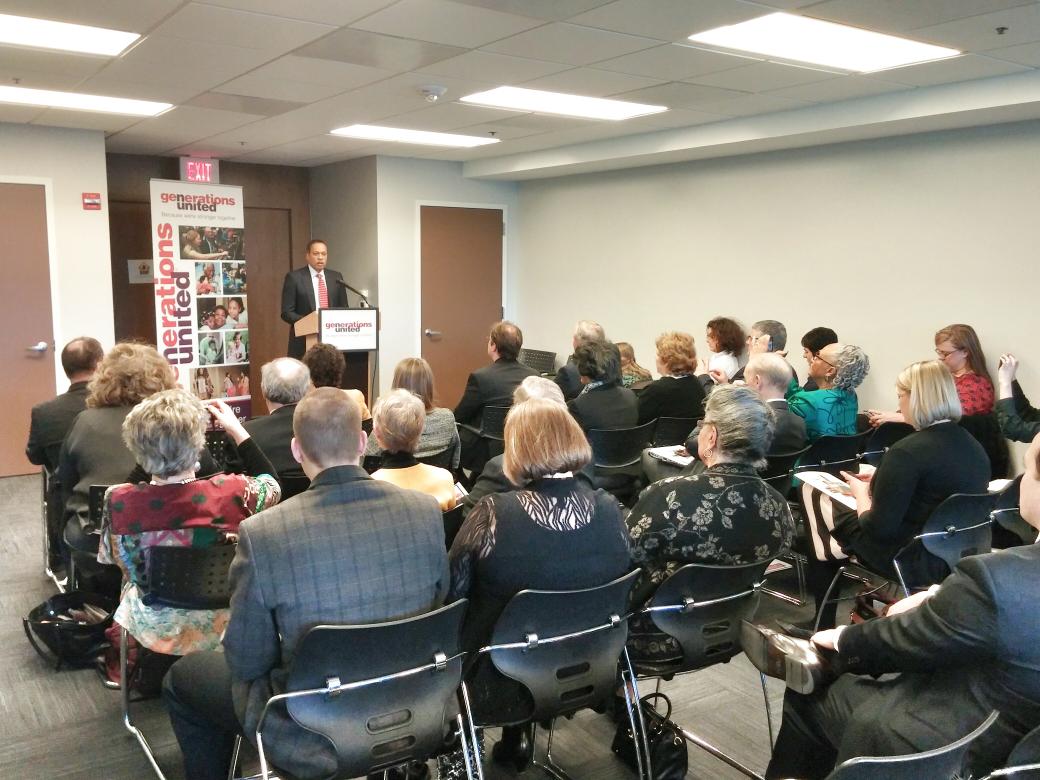 |
| (Click here to view enlarged image.) Author and journalist Juan Williams offers welcoming remarks. |
These communities – including Carlisle, MA; Greater Richmond Region, VA; and Greater Plymouth Area, WI – promote policies, programs, practices and services that increase cooperation, interaction and exchange between people of different generations.
“They are among the most vibrant, livable communities you will find anywhere in the nation,” Donna Butts, executive director of Generations United, told a packed room at the Hall of States.
Today, 8.4 million Americans live in such communities. This year’s honorees, combined, have a total of 1.2 million residents, which contributes to the total number of people living in age-friendly communities.
Butts praised the honorees' persistence in becoming age-optimized.
“As the communities we are recognizing today know,” she said, “it takes time, investments, commitment and leadership to bring younger and older people together in a true partnership that engages and respects the strengths of each generation.”
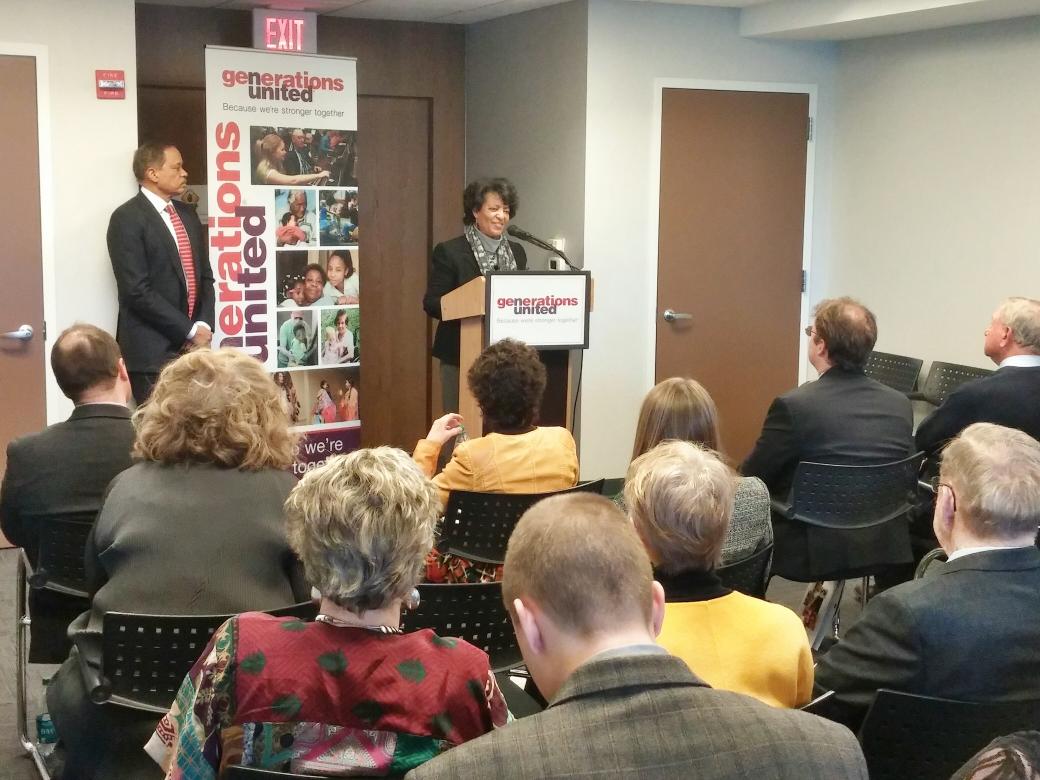 |
| (Click here to view enlarged image.) Thelma Collins, mayor of Itta Bena, MS (a 2013 winner) sharing how the award impacted her community. |
That time, investment and commitment paid off for our past winners like Itta Bena, MS (2013 winner).
“The award helped our community see we are moving in the right direction towards a healthier community for all ages,” said Thelma Collins, mayor of Itta Bena, MS. As a result of the award, she added, “We were recognized by the Obama administration and received one of 26 technical assistance grants to help us get a grocery store.”
Dennis White, CEO and president of MetLife Foundation, shared highlights from Maricopa County, AZ, and San Diego County, CA.
For Maricopa County, the award validated their work and helped raised morale among its residents.
San Diego County reported that the award got them the attention of their County Board of Supervisors who decided to start embracing intergenerational programming by voting to add four new intergenerational coordinators through their county.
 |
| MetLife Foundation's CEO and President Dennis White |
“We know the award has impacted the communities we’ve honored,” White said.
“We applaud today’s recipients of the Intergenerational Best Communities Award for unleashing the power of intergenerational connections that encourage people of all ages to thrive and work together to make their communities better places to grow up and grow old.”
The awards presentation took place on Capitol Hill and featured author and journalist Juan Williams and our Board member Jatrice Martel Gaither, executive vice president of External Affairs for Volunteers of America.
During her remarks, 11-year-old Margot, of Carlisle, shared a touching story about helping older adults in her community.
Drew Schweiger, 18, and his older adult buddy, Larry Bray, of Greater Plymouth Area, talked about the benefits of living in an age-friendly community.
As a mentor in the Greater Richmond Region’s Foster Grandparent Program, Doris Hairston sees first-hand the benefits of generations mixing it up.
She recounted a story about helping a challenged youth overcame various obstacles through problem-solving.
Hairston is fulfilled knowing she helps children like Charles.
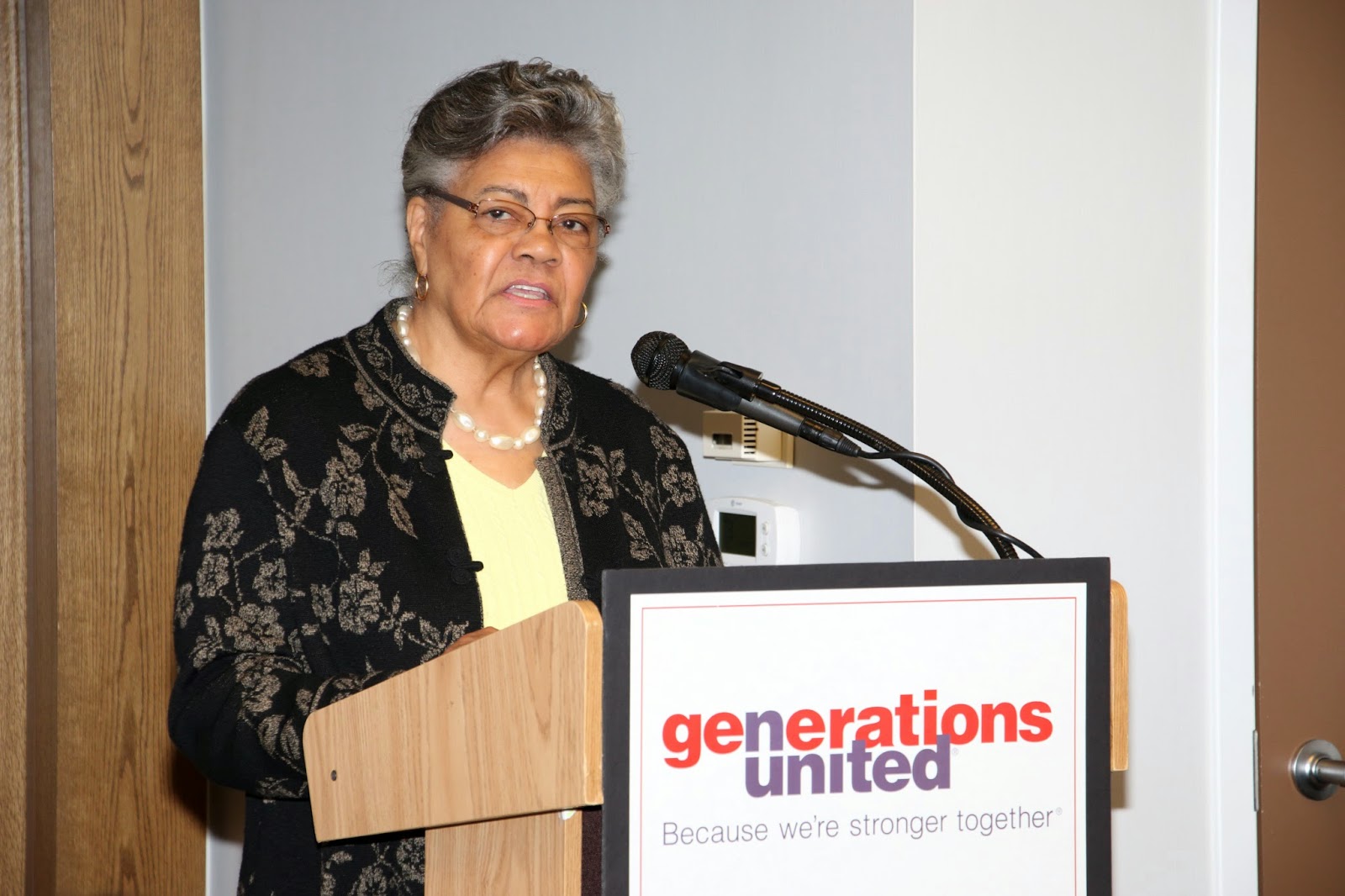 |
| Doris Hairston, of Greater Richmond Region, shares a story about helping a challenged youth overcome various obstacles through problem-solving. |
She recounted a story about helping a challenged youth overcame various obstacles through problem-solving.
Hairston is fulfilled knowing she helps children like Charles.
“Together,” she said, “the other volunteers and the children we work with are making positive differences in each other’s’ lives.”
Congratulations, again, to our winners. You can see other highlights here.
If you’re interested in more info about intergenerational communities, click here and share our resources with your networks.
Congratulations, again, to our winners. You can see other highlights here.
If you’re interested in more info about intergenerational communities, click here and share our resources with your networks.
Tuesday, February 10, 2015
Generation Exchange

EDITOR’S NOTE: Each week, we feature intergenerational program ideas that were tried and successful. This series is a tool to highlight various age-optimized programs and practices. The program descriptions are provided by representatives of the programs. Inclusion in this series does not imply Generations United’s endorsement or recommendation, but rather encourages ideas to inspire other programs.
In the latest of series, we feature Generation Exchange, based in Kansas City, MO.
(Check our archives for parts 1-31.)
Generation Exchange is an intergenerational storytelling (oral history) project designed to increase social interaction between youth and older adults.
Generation Exchange also offers the opportunity to preserve and carry on local history to future generations.
Through Generation Exchange, every older adult in the greater Kansas City region will have the opportunity to tell their story.
The goal of this project is to create a collection of stories that document memories and experiences related to neighborhood life, historical events, and cultural experiences that shaped the lives of previous generations.
Got something cool you tried that was successful? Why not tweet your cool intergenerational ideas to #cooligideas? You can also post them to our Intergenerational Connections Facebook Group or just text us through the Facebook Messenger app (friend me to join our Cool Intergenerational Ideas group discussion). We want to highlight innovative age-optimized programs and practices through our blog, social media and weekly e-newsletter! Share the inspiration.
Tuesday, February 03, 2015
mUsic Unites

In the latest of series, we feature mUsic Unites, based at Hebrew SeniorLife’s Jack Satter House in Revere, MA.
(Check our archives for parts 1-30.)
mUsic Unites is a intergenerational music program that operates from the premise that music can be a common denominator that unites us all, no matter our ages or backgrounds.
Each week, local high school students teach older adults how to play musical instruments (voice, piano, guitar, and drums).

Program participants are developing meaningful relationships with music as the medium; the high school students have become teachers and the older adults are realizing that there is no such thing as being "too old" when it comes to learning something new and achieving one's goals.
Monday, February 02, 2015
City of Surprise, Arizona - national finalist for the 2015 Best Intergenerational Communities Awards
 |
Mayor Sharon Walcott (center) joins council members and
the community for the Arts HQ ribbon cutting ceremony
in the Surprise Civic Center
|
A milestone was reached in 2008, when the City of Surprise and Benevilla, a human service non-profit organization, established the Community for All Ages (CFAA) partnership –which connected nonprofits, private businesses, academic institutions and city officials in a program to embrace the connections of the young and young-at-heart populations.
The CFAA provides intergenerational social interactions across all ages, ethnicities, economic status and/or disabilities by improving communication and community awareness.
“This partnership has connected toddlers with grandparents in healthy eating community gardening efforts and mind-stimulating games designed to support our elders with dementia, says Mayor Sharon Wolcott.
While the CFAA was solidified at the start of the recession, the City of Surprise and its partnering agencies were determined to implement programs and projects to support growing a connection between generations.
 |
| Surprise's Fiesta Grande event |
The City worked with its partners to coordinate events and vendors to complement one another and maximize resources.
Through a partnership with Benevilla and Rio Salado College’s Lifelong Learning program, the Community for All Ages partnership created an intergenerational campus in the city’s Historic Original Town Site in April 2009.
The Original Town Site also hosted the 1st Annual Surprise Fiesta Grande event that attracted more than 20 vendors and 15,000-plus resident in celebration of the city’s Mexican heritage.
"Our 75 guests from Nogales, Sonora, provided traditional folkloric and mariachi entertainment that got all residents dancing, no matter the age," Mayor Wolcott recalls.
"Our 75 guests from Nogales, Sonora, provided traditional folkloric and mariachi entertainment that got all residents dancing, no matter the age," Mayor Wolcott recalls.
 |
| 2012 Surprise Neighborhood Award Program |
In Surprise, they measure success in more ways than dollars and cents. For Surprise Grants Administrator Janeen Gaskin, the community’s sweat equity and volunteer spirit is what sets them apart from other communities.
Their sweat equity and volunteer spirit shines through their anti-graffiti project, which brought together volunteers from elementary schools and older adults to complete a 30-foot-wide mosaic tile mural in the community park.
Over the last three years, Vice Mayor John Williams added three new youth leadership opportunities that include the Youth Civic Leader Program, which gives high school students a chance to sit on the dais as a youth representative during City Council work sessions and meetings.
Since then, the city has launched a 26-member Surprise Youth Council that will work hand-in-hand with the City Council to recommend youth programs that will support the Council’s vision to create a community where young people grow up, work and raise their own families in Surprise.
"When I first moved to Surprise, I was concerned that my opportunities as a young person in this community would be limited because Surprise has a large retirement population," recalls Yazmin Padilla, Surprise Youth Civic Leader and Youth Advisory Commission Chair.
 |
| Surprise Youth Council Induction Ceremony |
Through the Youth Civic Leader Program, Padilla traveled to Washington, D.C., where she met with her elected state officials and advocated for young people in legislative initiatives.
The experience opened her eyes to how future leaders, such as herself, could make an impact.
"Not only have I been given the opportunity to perform volunteer activities," says Padilla. "But, myself and fellow youth have found Surprise to be a place where we can truly make
The experience opened her eyes to how future leaders, such as herself, could make an impact.
"Not only have I been given the opportunity to perform volunteer activities," says Padilla. "But, myself and fellow youth have found Surprise to be a place where we can truly make
an impact in our community."
Padilla was also part of a team that won an entrepreneurial scholarship from the city’s business incubator, the AZ TechCelerator, to create a locker rental business in a local charter school.
While the City of Surprise is honored to be recognized as the 2015 National Finalist for the Best Intergenerational Communities Award, they’re proud of the fact that the Maricopa Association of Governments and Benevilla were the 2014 winners for their intergenerational efforts in Surprise.
The City of Surprise, the Maricopa Association of Governments and Benevilla look forward to continuing to grow opportunities that bridge the age gap.
 "We are honored with the finalist selection this year,” Gaskins says, “and will continue to find new ways to connect our residents of all age to grow a stimulating community, that supports the needs of all residents, no matter their age.”
“This national recognition reflects that our city is truly a community of all ages,” said Mayor Sharon Wolcott. “In growing One Surprise, we champion our residents coming together in support of civic engagement, education, volunteerism and community pride.”
Greater Richmond Region, Virginia - 2015 Best Intergenerational Communities Award-winner
 |
With the community’s commitment of connecting people across generations, Link is convinced her family made the right decision.
With over 40 local intergenerational programs, festivals, events and leisure activities bringing together its 1 million-plus residents of all ages, it’s obvious Greater Richmond Region thrives off meaningful connections between older adults and youth.
With all ages being an integral and valued part of the setting, they couldn’t wait to share their community pride by applying for the 2015 Best Intergenerational Communities Awards.
“I knew Richmond had a strong chance of winning,” said Sara Link, director of Greater Richmond Age Wave, a collaborative that includes philanthropists, local government, businesses, nonprofits and academia working together to maximize resources for all ages.
Link’s Age Wave manages CATCH Healthy Habits, a Generations United 2015 Program of Distinction re-designee that was first honored in 2012.
Through this evidence-based program – hosted by Senior Connections, The Capital Area Agency on Aging and Virginia Commonwealth University Department of Gerontology – older adult volunteers teach K-5 students the value of healthy eating and physical activity.
 |
Programs like CATCH Healthy Habits stem from Greater Richmond Region’s intergenerational roots, which go back to 1984, when Westminster Canterbury Richmond became an intergenerational shared site after including a Child Development Center with its Continuing Care Retirement Community.
Today, Westminster Canterbury Richmond’s intergenerational programs bring together children and older adults for daily story time and annual events/performances.
Today, Westminster Canterbury Richmond’s intergenerational programs bring together children and older adults for daily story time and annual events/performances.
A community jewel is the James River Park System, 600 protected acres of shoreline and river islands running through the community.
The River System functions as an outdoor classroom for all ages to learn and appreciate Greater Richmond Region’s history while enjoying mountain biking, fishing and kayaking.
Youth and older adults also engage through the YMCA of Greater Richmond’s Growing Younger program, an initiative of United Way of Greater Richmond & Petersburg (GRP) in partnership with Friendship Cafes.

“Elders in this program are actively engaged in physical exercise and projects with youth, as well as the arts,” said Lynn H. Pharr, United Way-GRP chief executive officer.
In addition to funding from United Way-GRP, Greater Richmond Region’s intergenerational programs receive nearly $1 million in combined support from by county and city governments as well as public and private foundations.
As a mentor in the Richmond Area Foster
Grandparent Program, Doris Hairston sees first-hand how those investments contribute to the community’s intergenerational success stories.
She and nearly 70 other older adults serve as mentors, tutors and caregivers for Greater Richmond Region’s children and youth with special needs.
“Many of the children served throughout the history of our successful program,” Hairston explained, “are now contributing adults themselves.”
“Many of the children served throughout the history of our successful program,” Hairston explained, “are now contributing adults themselves.”
 The Greater Richmond Region is still feeling the excitement from a Generations United announcement that they are a 2015 Best Intergenerational Communities Award-winner.
“We will continue celebrating with Chesterfield County and the City of Richmond as we present a flag and road sign to each locality to have on display,” said Sara Link, who shared the news with various media outlets and through social media.
Sadie Rubin, director of the intergenerational arts program PALETTE, hopes the award will attract new funding.
Sara Morris, coordinator of CATCH Healthy Habits and Greater Richmond Age Wave, is still ecstatic about the award.
“It will help break down barriers people may have about other generations,” she said. “It will foster [more] community collaboration and innovative thinking that is cross generational.”
Tuesday, January 27, 2015
Dance Generators West
EDITOR’S NOTE: Each week, we feature intergenerational program ideas that were tried and successful. This series is a tool to highlight various age-optimized programs and practices. The program descriptions are provided by representatives of the programs. Inclusion in this series does not imply Generations United’s endorsement or recommendation, but rather encourages ideas to inspire other programs.

In the latest of series, we feature Dance Generators West, based in San Francisco.
(Check our archives for parts 1-29.)
Dance Generators West is a part of the University of San Francisco's Department of Performing Arts and Social Justice.
Company members range in age from their teens through their eighties.
The Company believes that the combinations of physical and creative energies found in dance succeeds in motivating and inspiring activity and interaction between people of all ages who are at times, isolated from one another.
Through dance, the company shatters commonly held stereotypes about ageing, and creates bridges between people of all ages. Dance Generators show audiences that people who have been in motion for over 50 years bring unique qualities to dance.
Our performances combine improvisation, choreographed work, and audience participation.
 Dance Generators introduce audiences to the tools and skills used in creating dances. They explore the process of dance-making through interactive activities and demonstrations.
Dance Generators’ performances show that people at any age can be physically and artistically vital. Through individual and group expression and movement, ideas and stories are shared that transcend age differences.
Got something cool you tried that was successful? Why not tweet your cool intergenerational ideas to #cooligideas? You can also post them to our Intergenerational Connections Facebook Group or just text us through the Facebook Messenger app (friend me to join our Cool Intergenerational Ideas group discussion). We want to highlight innovative age-optimized programs and practices through our blog, social media and weekly e-newsletter! Share the inspiration.
Subscribe to:
Posts (Atom)